
Why Electrolytes Have Lower Conductivity Than Metallic Conductors – Full Guide
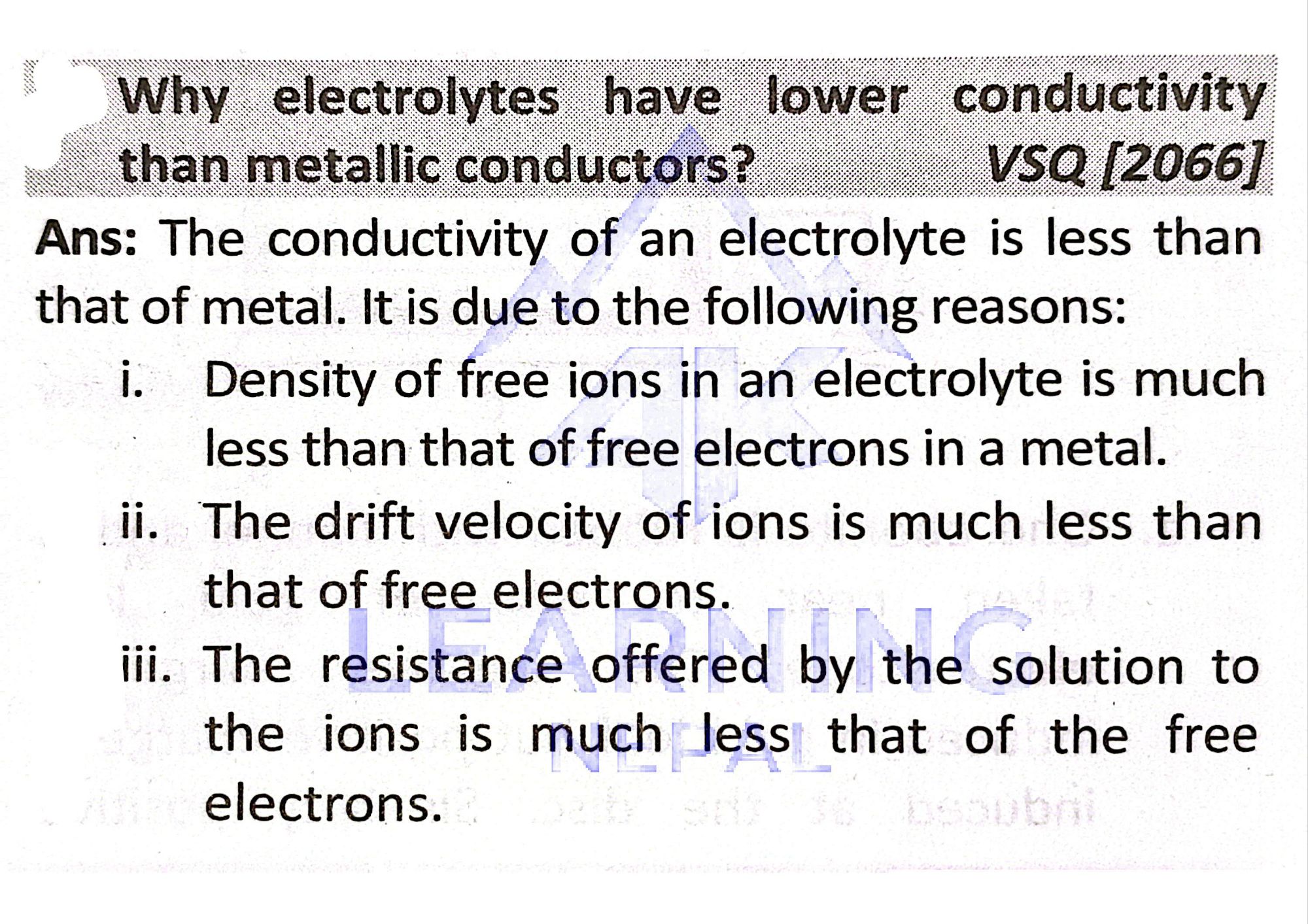
Electrolytes generally have lower conductivity compared to metallic conductors because the movement of ions in solution is slower than the flow of free electrons in metals. In this post, we explain why electrolytes have lower conductivity than metallic conductors in a simple and educational way.

Factors Affecting Electrolyte Conductivity
The conductivity of electrolytes depends on ion mobility, concentration, and the nature of the solvent. Unlike metals, where electrons are free to move, ions in electrolytes face resistance due to collisions with solvent molecules and other ions.
Comparison With Metallic Conductors
- Metallic conductors have free electrons for conduction.
- Electrolytes rely on ion movement, which is slower.
- Temperature affects electrolytes more significantly.
- Resistance in electrolytes is higher due to collisions.
- Metals show nearly uniform conductivity.
Electrolyte conductivity can be improved by increasing concentration or using highly mobile ions, but it rarely reaches the conductivity of metals.
Keywords
why electrolytes have lower conductivity than metallic conductors, electrolyte conductivity, metallic conductors, ion mobility, electron flow, electrical conduction, resistance in electrolytes, physics concepts, conductivity comparison, ionic conduction, metallic vs electrolyte, electric current in solutions, chemistry physics guide, conductivity factors, electrochemistry,Why Electrolytes Have Lower Conductivity Than Metallic Conductors
Tags
electrolytes, metallic conductors, conductivity, ionic conduction, electron flow, physics, chemistry, electrochemistry, resistance, educational post, physics concepts, learning conductivity, electric current, chemistry guide, science education
Search more on Google:
Click Here
Why Electrolytes Have Lower Conductivity Than Metallic Conductors
Helpful resource:
Electrolytes – Wikipedia