
What is the Value of Work Done When Force and Displacement Are Parallel With Each Other?
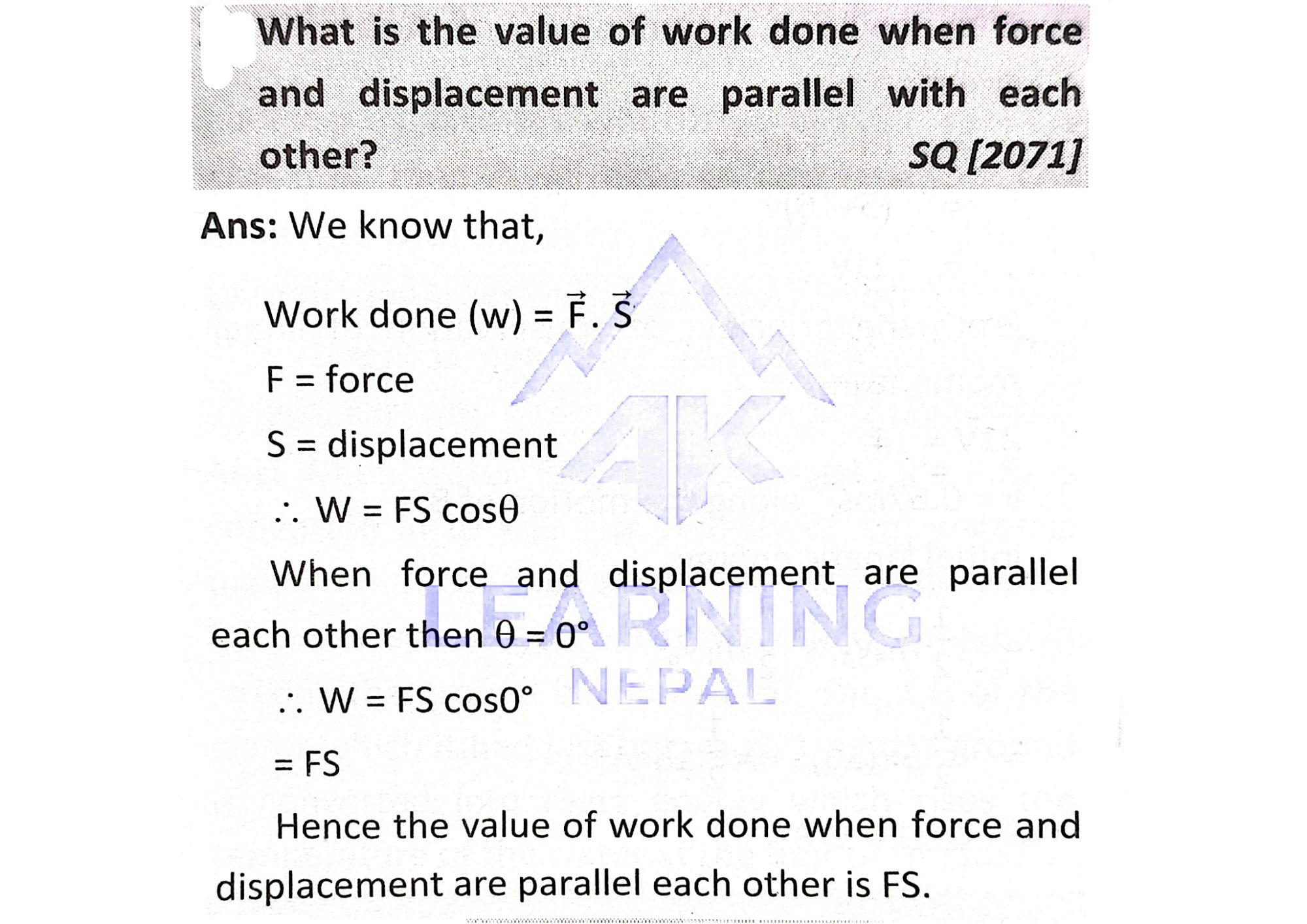

What is the value of work done when force and displacement are parallel with each other — this is a fundamental concept in physics that tells us how to compute work when the force and displacement act in the same direction.
Definition of Work (Force & Displacement Parallel)
When a constant force acts on an object and the object moves such that its displacement is in the same direction as the force, the work done (W) is simply the product of the magnitude of the force (F) and the magnitude of the displacement (d). :contentReference[oaicite:0]{index=0}
Formula: W = F × d
Because the force and displacement are parallel (angle θ = 0°), the general formula W = F × d × cos θ reduces to:
W = F × d × cos 0° = F × d
:contentReference[oaicite:1]{index=1}
Important Conditions and Interpretation
- The force must act in the direction of displacement for maximum (positive) work. :contentReference[oaicite:2]{index=2}
- If force and displacement are perpendicular → no work done. :contentReference[oaicite:3]{index=3}
- If force acts opposite to displacement (i.e. opposite direction) → negative work (work done against motion). :contentReference[oaicite:4]{index=4}
Related: Internal link here
Read More About Work Done by Force (DoFollow)