
AK Learning Nepal

  Thursday 16 October 2025 / 01:43 PM

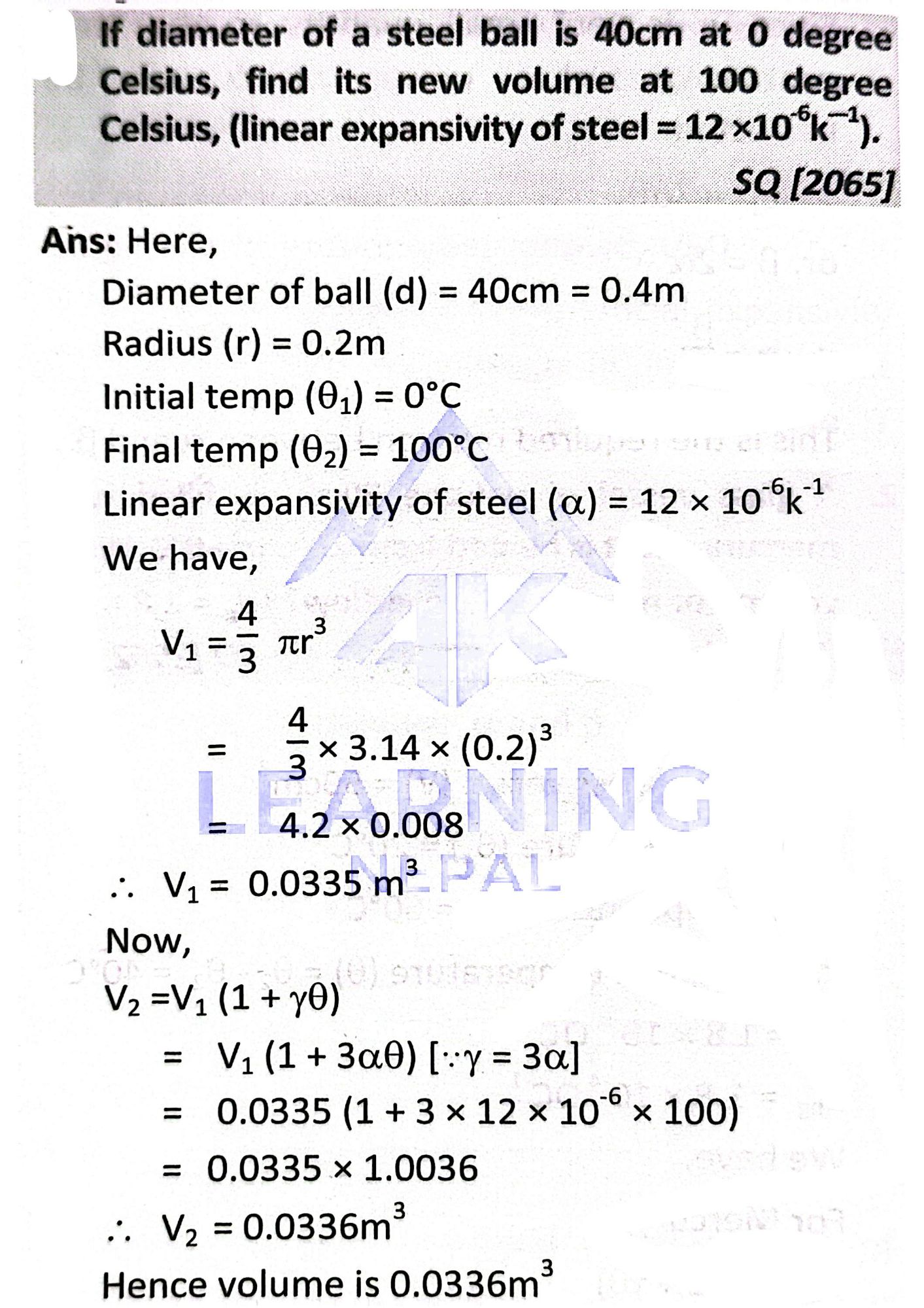
If Diameter of a Steel Ball is 40 cm at 0 °C — Find Its New Volume at 100 °C
 

Search on Google

steel ball diameter 40 cm 0 degree C new volume at 100 degree C

If diameter of a steel ball is 40 cm at 0 °C — find its new volume at 100 °C is a typical physics problem dealing with volumetric expansion of solids due to temperature rise.

Concept: Volumetric Thermal Expansion

When a solid body is heated, its volume increases. The change in volume depends on its initial volume, temperature change, and coefficient of volumetric expansion. The formula generally used: ΔV = 3 α V₀ ΔT, where α is linear expansion coefficient.

Calculation Steps

Given: initial diameter = 40 cm → radius = 20 cm. So initial volume V₀ = (4/3) π r³ = (4/3) π (20 cm)³.

Assume coefficient of linear expansion of steel, α ≈ 12 × 10⁻⁶ /°C. Then volumetric expansion coefficient is approx 3α ≈ 36 × 10⁻⁶ /°C. With ΔT = 100 °C − 0 °C = 100 °C, change in volume ΔV ≈ 3α V₀ ΔT.

So new volume V = V₀ + ΔV = V₀ [1 + 3α ΔT].

Note: Actual increase will be small — even with 100 °C rise, expansion in solids is very modest due to small α. Always consider significant figures carefully.

Related: Internal link here

If Diameter of a Steel Ball is 40 cm at 0 °C — Find Its New Volume at 100 °C

Read More About Thermal Expansion (DoFollow)

Keywords

steel ball thermal expansion, volumetric expansion, volume change with temperature, physics expansion example, steel expansion coefficient, ball volume calculation, expansion of solids, class 11 physics, temperature rise effect, volume at 100C, thermal physics, expansion formula, initial diameter 40 cm, volume expansion problem, thermal expansion physics

Tags

thermal expansion, steel ball, physics class 11, volume expansion, heat effect on solids, physics tutorial, expansion problem, thermal physics, science notes, expansion coefficient, physics example, ball volume, expansion of materials, educational physics, school physics,If Diameter of a Steel Ball is 40 cm at 0 °C — Find Its New Volume at 100 °C

Leave a Reply

Scroll to Top