
Basic Medical Procedure and First Aid

General Medicine (HA) – Second Year
Unit 8: First Aid
The Critical Role of First Aid
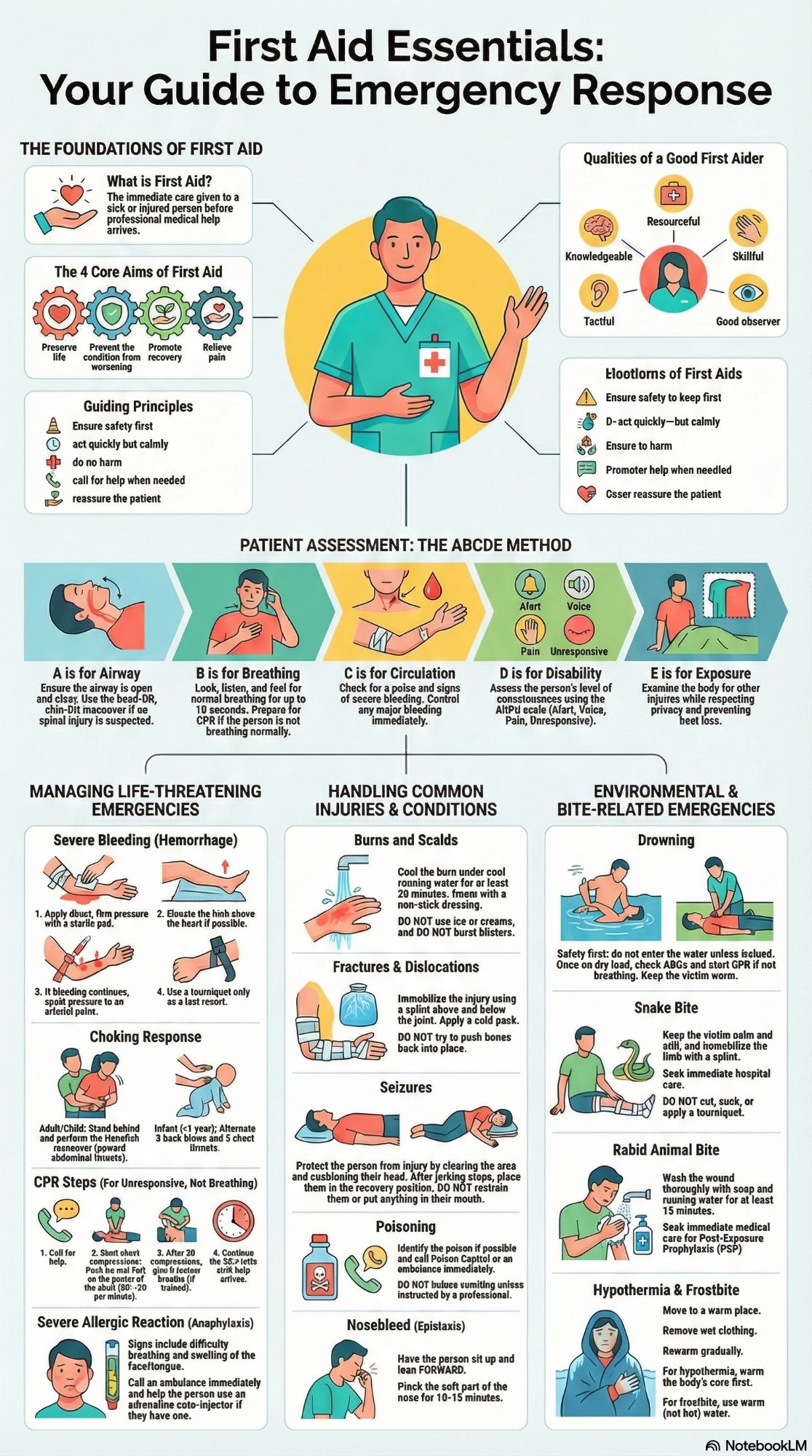
First aid is the immediate, initial assistance given to any person suffering from either a minor or serious illness or injury. The goal is to preserve life, prevent the condition from worsening, and promote recovery until professional medical help arrives. This unit covers the fundamental principles of first aid, patient assessment using the ABCDE method, and specific management for a wide range of emergency conditions from drowning to cardiac arrest.
Proper first aid can mean the difference between life and death, temporary and permanent disability, or rapid recovery and long-term complications. Follow the Basic Medical Procedures and First Aid Page for more resources and demonstrations.
Fundamentals of First Aid
Definition & Aims
Definition: Immediate care given to a sick or injured person before professional medical help arrives.
Aims of First Aid
- Preserve life
- Prevent condition from worsening
- Promote recovery
- Relieve pain and suffering
- Protect the unconscious
Principles & Importance
Principles of First Aid
- Ensure safety of rescuer and victim
- Act quickly but calmly
- Do no harm (non-maleficence)
- Call for medical help when required
- Reassure the patient
- Use available resources wisely
Importance of First Aid
- Saves lives in emergencies
- Prevents complications
- Reduces recovery time
- Critical in disasters and accidents
- Builds confidence in handling emergencies
First Aid Box Essentials
The Effective First Aider
Qualities of a First Aider
- Resourceful: Uses available materials creatively
- Skillful: Trained and competent in techniques
- Tactful: Calm, polite, and reassuring
- Knowledgeable: Understands first aid principles
- Observant: Identifies signs and symptoms early
- Decisive: Makes quick, appropriate decisions
Responsibilities
- Assess the situation safely
- Ensure scene safety
- Provide correct first aid
- Arrange transport/referral
- Maintain confidentiality
- Reassure the patient
- Document if possible
Patient Assessment: The ABCDE Method
A systematic approach for all critical patients. Follow in sequence.
Emergency Conditions & First Aid Management

A. Drowning
Definition: Respiratory impairment from submersion/immersion in liquid.
First Aid Steps
- Safety First: Do not enter water unless trained. Use reach/throw items.
- Get victim to dry land safely.
- Check ABCs. If not breathing, begin Rescue Breathing/CPR immediately.
- Place in recovery position if breathing but unconscious.
- Keep warm, monitor continuously.
- All drowning victims need medical evaluation.
⚠️ Critical Points
No Heimlich for water: Do not perform abdominal thrusts to remove water. Focus on airway and breathing.
B. Burns & Scalds
Types: Thermal, Chemical, Electrical, Radiation.
First Aid Protocol
- Stop burning: Remove from source. Smother flames.
- Cool burn: Cool running water for ≥20 min (not ice).
- Remove: Gently remove constrictive items.
- Cover: Use sterile non-stick dressing/cling film.
- Do NOT: Apply ice, creams, or burst blisters.
- Refer: All major burns need hospital care.
🚨 For Chemical Burns
Brush off dry chemicals first, then irrigate with copious water for 30-60 minutes. Remove contaminated clothing.
C. Hemorrhage (Severe Bleeding)
First Aid for External Bleeding
- Wear gloves if available.
- Direct pressure: Use sterile pad on wound.
- Elevate: Injured part above heart (if no fracture).
- If bleeding soaks through, add another pad on top.
- If severe bleeding continues, use arterial pressure point.
- Tourniquet: Last resort. Wide band, note time.
Primary method
Above heart level
Brachial/Femoral
Last option
D. Fractures & Dislocations
First Aid Principles
- Follow DRABC first (Danger, Response, Airway, Breathing, Circulation).
- Control bleeding, cover open wounds.
- Immobilize: Splint above and below the joint.
- Check CMS (Circulation, Movement, Sensation) before/after.
- Apply cold pack for swelling/pain.
- Treat for shock: keep warm, elevate legs (if no lower limb injury).
- DO NOT try to re-align bones or joints.
🩹 Splinting Tips
Use commercial splints or improvised materials (sticks, rolled magazines, cardboard). Pad splint to prevent pressure sores.
E. Choking & Foreign Bodies
Heimlich Maneuver (Conscious Adult)
- Stand behind, wrap arms around waist.
- Make fist above navel, thumb side in.
- Grasp fist with other hand.
- Give quick upward thrusts until object expelled.
Infants (<1 year)
- Alternate 5 back blows with 5 chest thrusts.
- Support head and neck throughout.
- Never perform abdominal thrusts on infants.
F. Epistaxis & Seizure
Nosebleed (Epistaxis)
- Sit up, lean forward (not backward).
- Pinch soft part of nose firmly for 10-15 min.
- Breathe through mouth.
- Apply cold compress to bridge of nose.
- Do NOT: Tilt head back or pack roughly.
Seizure First Aid
- Stay calm. Time the seizure.
- Protect from injury: move objects, cushion head.
- Do NOT restrain or put anything in mouth.
- Place in recovery position after jerking stops.
- Stay until fully recovered.
- Call ambulance if: >5 min, first seizure, in water, or consecutive seizures.
G. CPR (Cardio-Pulmonary Resuscitation)
For Unresponsive, Not Breathing Normally
Check & Call
Check response and breathing. Call for help/ambulance immediately.
Chest Compressions
Center of chest, 5-6 cm deep, 100-120/min. Hard and fast.
Rescue Breaths
If trained: 30 compressions → 2 breaths. Head-tilt, chin-lift, pinch nose.
Continue
Continue 30:2 until help arrives, AED arrives, or signs of life.
⚠️ CPR Key Points
- Push hard, push fast (100-120 compressions/minute)
- Allow complete chest recoil between compressions
- Minimize interruptions in chest compressions
- Switch rescuers every 2 minutes if possible to prevent fatigue
- Use AED as soon as available
Special Emergency Conditions
Poisoning
- Ensure safety first
- Identify poison if possible
- Call Poison Control
- Do NOT induce vomiting
- Monitor ABCs
- Bring poison container to hospital
Snake Bite
- Keep victim calm and still
- Immobilize the limb
- DO NOT cut, suck, or tourniquet
- Wash with soap/water
- Transport to hospital immediately
- Note snake appearance
Rabid Animal Bite
- Wash wound with soap/water for 15 min
- Apply antiseptic
- Immediate medical referral for PEP
- Rabies is nearly 100% fatal once symptoms appear
- Post-exposure prophylaxis is critical
Anaphylaxis
- Life-threatening emergency
- Call ambulance immediately
- Use epinephrine auto-injector if available
- Help sit up for easier breathing
- Monitor ABCs, be ready for CPR
- Transport even if symptoms improve
Hypothermia/Frostbite
- Move to shelter/warmth
- Remove wet clothing
- Warm core first (trunk)
- Gradual rewarming for frostbite
- Do not rub frostbitten areas
- Warm drinks if conscious
High Altitude Sickness
- Stop ascent immediately
- Descend if symptoms worsen
- Provide oxygen if available
- Keep hydrated
- Monitor for HAPE/HACE signs
- Acclimatize properly for prevention
📚 Memory Aids & Key Points
ABCDE Mnemonic
Alligators Bite Crocodiles During Emergencies
(Airway, Breathing, Circulation, Disability, Exposure)
Burn Care: “Cool, Cover, Call”
Cool with running water (20 min)
Cover with sterile dressing
Call for medical help for serious burns
Fracture Rules
Support the injury
Prevent movement
Look for CMS changes
Immobilize properly
No attempts to realign
Transport to hospital
Topic Tags
CPR
ABCDE Assessment
Drowning
Burns Management
Hemorrhage Control
Fracture First Aid
Choking
Heimlich Maneuver
Seizure First Aid
Poisoning
Snake Bite
Anaphylaxis
Hypothermia
Emergency Response
First Aid Kit
Tourniquet Use
Rabies Prevention
Altitude Sickness
Epistaxis
📋 Summary & Key Points
- Scene Safety: Always ensure your safety first before helping others
- ABCDE Approach: Systematic assessment for all critical patients
- CPR: Push hard, push fast (100-120/min), allow chest recoil
- Bleeding Control: Direct pressure, elevation, pressure points, tourniquet as last resort
- Burns: Cool with running water for 20 minutes, cover, do not apply creams
- Fractures: Immobilize, check CMS, do not attempt to realign
- Poisoning: Do not induce vomiting unless instructed, identify poison if possible
- Snake Bite: Keep victim still, immobilize limb, transport to hospital (no cutting/sucking)
- Anaphylaxis: Epinephrine is first-line treatment, call ambulance immediately
- First Aider Role: Provide care until professional help arrives, document if possible
For more resources, contact via WhatsApp: 9816819593 or visit CTEVT Nepal