
Basic Medical Procedure and First Aid

General Medicine (HA) – Second Year
Unit 4: Administration of Drugs
Importance of Safe Drug Administration
Proper drug administration is a fundamental skill for all healthcare professionals. Medication errors can lead to serious patient harm, prolonged hospitalization, and increased healthcare costs. This unit covers the systematic approach to administering medications safely, understanding different routes, calculating accurate doses, and managing oxygen therapy and nebulization.
Mastering these skills ensures therapeutic effectiveness while minimizing risks. Follow the Basic Medical Procedures and First Aid Page for more resources.
1. Definition & Purpose of Drug Administration
Definition: Process of giving a prescribed substance to achieve diagnostic, therapeutic, or preventive effects.
Purposes:
- Prevent, treat, or cure diseases
- Relieve symptoms (pain, fever)
- Replace deficient substances (hormones, vitamins)
- Aid in diagnosis (contrast dye for X-rays)
- Maintain overall health and well-being
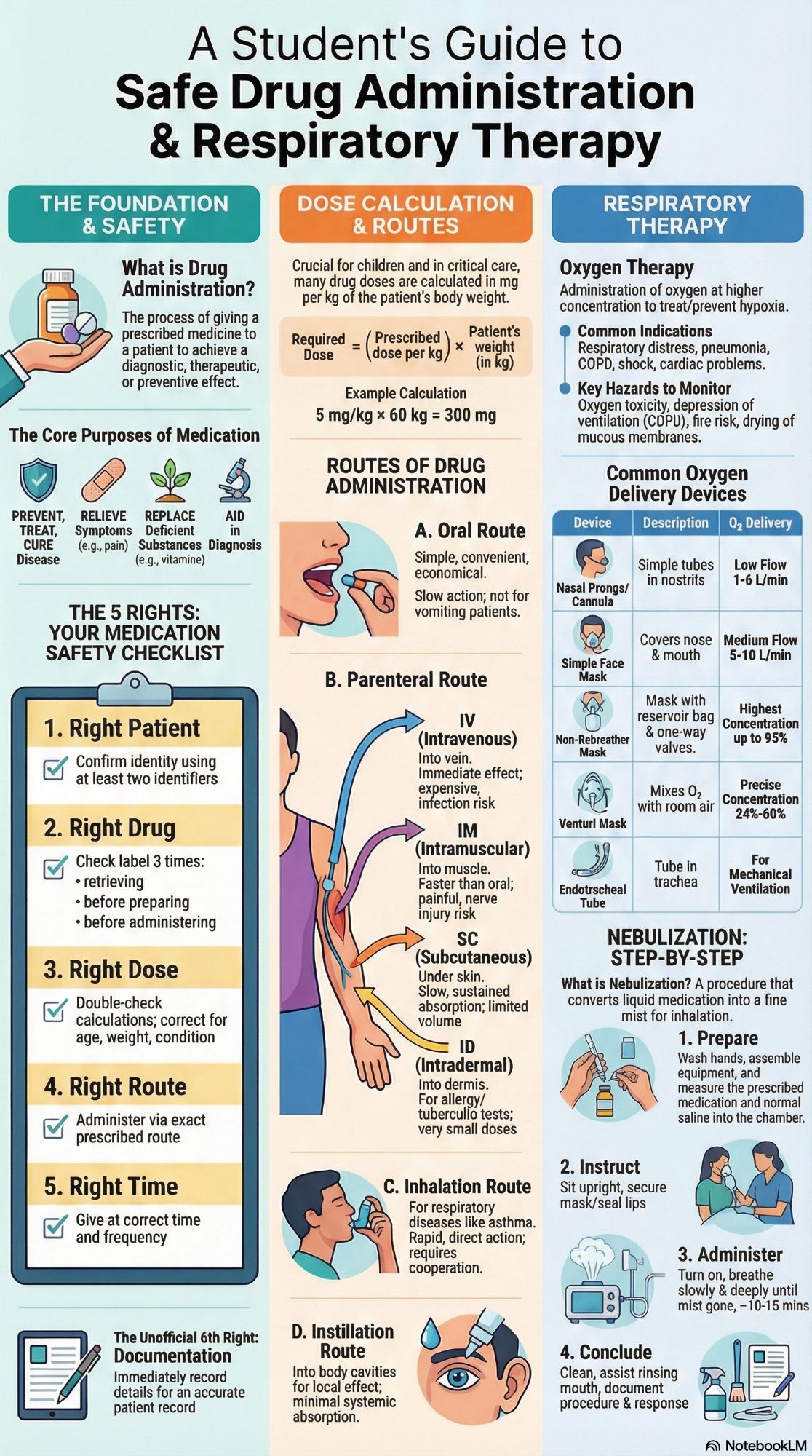
2. The 5 Rights in Administration of Drugs
⚠️ CRITICAL SAFETY CHECKLIST – Prevent Medication Errors
Right Drug
Check label 3 times: from storage, before preparing, before administering
Right Dose
Ensure correct dose per age, weight, condition. Double-check calculations
Right Route
Administer exactly as prescribed (oral, IV, IM, etc.)
Right Time
Give at correct time and frequency (before meals, every 8 hours)
📝 Remember: Right Documentation (the 6th Right) – Record administration immediately after giving the drug.

3. Medicine Calculation According to Body Weight
Many drug doses, especially for children and in critical care, are calculated based on body weight (mg per kg of body weight).
📐 Formula
Required Dose = (Prescribed dose per kg) × Patient’s weight (in kg)
📝 Example
A doctor prescribes 5 mg/kg of a drug. The patient weighs 60 kg.
Required Dose = 5 mg/kg × 60 kg = 300 mg
⚠️ Accurate calculation is very important to avoid overdose or underdose.
5. Routes of Drug Administration
A. Oral Route
Definition: Giving medicine through the mouth (tablets, capsules, syrup)
Advantages
- Simple and convenient
- Economical
- No pain
- No special skill needed
Disadvantages
- Slow action
- Not suitable for vomiting patients
- Not for unconscious patients
- Drug may be destroyed by gastric acid
Procedure (Oral Administration)
- Verify prescription
- Identify patient using two identifiers
- Give medicine with adequate water
- Ensure patient swallows medicine completely
- Record administration immediately
B. Parenteral Route (By Injection)
| Route | Definition | Common Sites |
|---|---|---|
| IV Intravenous |
Directly into vein | Cephalic, basilic, median cubital veins |
| IM Intramuscular |
Into muscle tissue | Deltoid, gluteal, vastus lateralis |
| SC Subcutaneous |
Under the skin | Abdomen, upper arm, thigh |
| ID Intradermal |
Into dermis layer | Inner forearm (TB test) |
IV Administration Procedure
- Wash hands and wear gloves
- Prepare drug aseptically
- Select appropriate vein
- Clean site with antiseptic
- Insert needle at 15-30 degree angle
- Inject drug slowly
- Observe patient for reactions
- Dispose needle safely
C. Inhalation & D. Instillation Routes
Inhalation Route
Definition: Drug given through breathing (respiratory tract)
Purpose: Respiratory diseases (asthma, COPD)
Advantages
- Rapid action
- Direct effect on lungs
- Minimal systemic side effects
Disadvantages
- Needs patient cooperation
- Improper technique reduces effect
- May cause throat irritation
Instillation Route
Definition: Drug dropped into body cavities
Examples: Eye drops, ear drops, nasal drops
Advantages
- Local effect
- Minimal systemic effect
- Easy to administer
Disadvantages
- Needs proper technique
- Risk of contamination
- May cause local irritation
6. Oxygen Inhalation (Oxygen Therapy)
Definition: Administration of oxygen at higher concentration than atmospheric air to improve oxygen supply.
Indications
- Respiratory distress
- Pneumonia
- COPD exacerbation
- Shock
- Cardiac problems
- Carbon monoxide poisoning
Hazards of Oxygen Therapy
- Oxygen Toxicity: Lung damage with high concentrations
- Depression of Ventilation: In COPD patients
- Fire Hazard: Oxygen supports combustion
- Drying of Mucous Membranes: Nosebleeds, dryness
Oxygen Delivery Devices
| Device | Flow Rate | O₂ Concentration | Use |
|---|---|---|---|
| Nasal Prongs | 1-6 L/min | 24-44% | Low flow, comfortable |
| Simple Face Mask | 5-10 L/min | 40-60% | Medium flow |
| Non-Rebreather Mask | 10-15 L/min | Up to 95% | High concentration |
| Venturi Mask | Variable | 24-60% (precise) | COPD patients |
7. Nebulization
Definition: Converting liquid medication into fine mist (aerosol) for inhalation into lungs.
Indications
- Asthma, COPD exacerbation
- Bronchodilator administration
- Steroid delivery to lungs
- To loosen thick secretions
- Antibiotic delivery for lung infections
Procedure
- Wash hands, assemble equipment
- Measure medication and normal saline
- Connect chamber to compressor
- Instruct patient to sit upright
- Turn machine on, breathe slowly/deeply
- Continue 10-15 minutes
- Clean equipment, rinse mouth
- Document procedure and response
📚 Memory Aids & Key Points
The 5 Rights Mnemonic
Patient • Drug • Dose • Route • Time
“Please Double-check Drugs Rightly & Timely”
Injection Sites Memory Aid
IM: Deltoid (arm), Gluteal (buttock), Vastus lateralis (thigh)
“Don’t Give Vaccines in Buttocks” – DG ViB
SC: Abdomen, Upper arm, Thigh
“AUT” – Abdomen Upper Thigh
Oxygen Safety Rules
- No smoking near oxygen
- Secure oxygen cylinders
- Monitor SpO₂ regularly
- Humidify if >4 L/min
🩺 Clinical Tips & Best Practices
Safety First
- Always verify patient identity with TWO identifiers
- Calculate doses independently, then double-check
- Never administer medication prepared by someone else
- Document immediately after administration
Patient Education
- Explain purpose of medication
- Teach proper inhaler technique
- Instruct on oxygen safety at home
- Discuss potential side effects
Special Considerations
- Elderly: Reduced renal/hepatic function
- Children: Weight-based dosing critical
- Pregnancy: Teratogenic risk assessment
- Renal impairment: Dose adjustment needed
Topic Tags
5 Rights of Medication
Dose Calculation
Oral Route
Parenteral Route
Intravenous
Intramuscular
Subcutaneous
Inhalation
Instillation
Oxygen Therapy
Nebulization
Medication Safety
Body Weight Dosing
Pharmacology
Therapeutic Effect
Hypoxia Management
Respiratory Therapy
Clinical Skills
Healthcare Procedures
📋 Summary & Key Points
- Always follow the 5 Rights to prevent medication errors
- Accurate dose calculation based on weight is critical for safety
- Choose the appropriate route based on drug properties and patient condition
- Parenteral routes require strict aseptic technique
- Oxygen therapy must be carefully monitored for hazards
- Nebulization delivers medication directly to lungs for respiratory conditions
- Documentation is the 6th Right – record immediately after administration
- Consider patient-specific factors (age, renal function, comorbidities)
For more resources, contact via WhatsApp: 9816819593 or visit CTEVT Nepal
Basic Medical Procedure and First Aid – Unit Wise Notes
Past Year Questions
Important Questions