
Basic Medical Procedure and First Aid
General Medicine (HA) – Second Year

Unit 2: Assessment of Vital Signs
Importance of Vital Signs Assessment
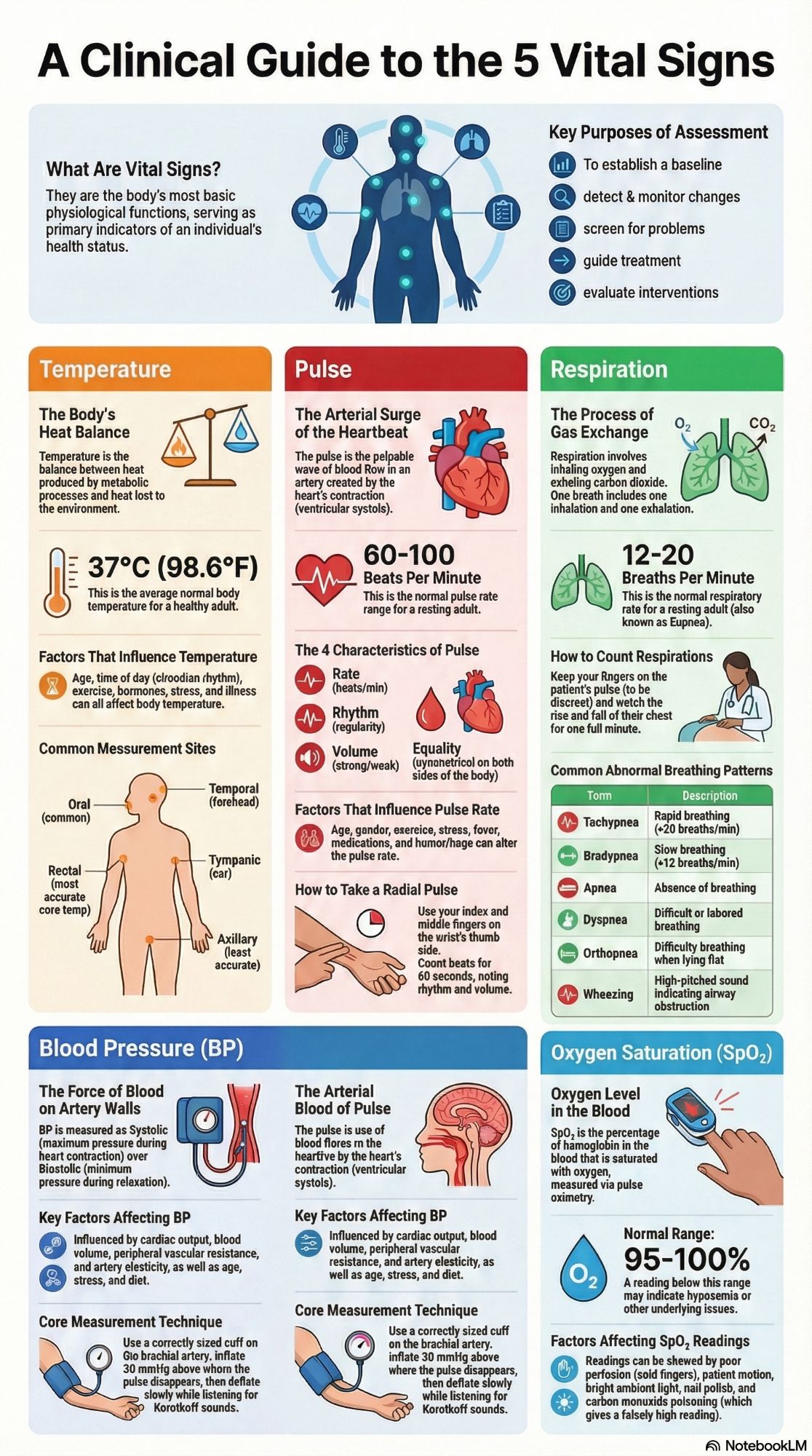
Vital signs are the most critical clinical measurements in patient assessment. They provide immediate information about a patient’s physiological status and can indicate life-threatening conditions. This unit covers the systematic approach to measuring and interpreting temperature, pulse, respiration, blood pressure, and oxygen saturation – the five key vital signs.
Mastering these skills is essential for early detection of patient deterioration, monitoring treatment effectiveness, and making informed clinical decisions. Follow the Basic Medical Procedures and First Aid Page for more resources.
1. Vital Signs: Definition and Purposes
Definition: Clinical measurements of the body’s most basic physiological functions. Primary indicators of health status.
Purposes:
- Establish baseline health status
- Detect and monitor changes in condition
- Screen for potential health problems
- Guide clinical decision-making
- Evaluate effectiveness of interventions
- Meet legal and institutional requirements
2. Temperature
Normal: 37°C (98.6°F)
Factors affecting temperature: Age, circadian rhythm, exercise, hormones, stress, environment, food intake, illness
Temperature Measurement Sites
| Site | Accuracy | Use |
|---|---|---|
| Oral (Mouth) | High | Most common, convenient |
| Tympanic (Ear) | High | Quick, reflects core temp |
| Rectal | Highest | Infants, most accurate |
| Axillary | Lowest | Screening only |
📝 Types of Fever
- Constant: Remains high with little fluctuation
- Remittent: Fluctuates but doesn’t return to normal
- Intermittent: Rises and falls to normal periodically
- Relapsing: Occurs for days, subsides, reappears
3. Pulse
Normal adult range: 60-100 bpm
Characteristics: Rate, Rhythm, Volume/Strength, Equality

Common sites: Radial (most common), Carotid (emergencies), Apical (most accurate)
Procedure for Radial Pulse
- Position patient’s arm comfortably, palm down
- Place index and middle fingers on radial artery
- Note rhythm and volume first
- Count beats for 60 seconds (or 30 sec × 2)
- Document rate, rhythm, and volume
Principle: Use fingertips (not thumb) to compress artery gently against bony surface.
4. Respiration
Normal (Eupnea): 12-20 breaths/min (adults)
Types: External (lungs), Internal (tissues), Cellular (metabolic)
Procedure: Keep fingers on pulse, observe chest rise/fall, count for 60 seconds
Abnormal Respiratory Patterns
| Term | Description |
|---|---|
| Tachypnea | Rapid rate (>20 bpm) |
| Bradypnea | Slow rate (<12 bpm) |
| Apnea | Absence of breathing |
| Dyspnea | Difficult/labored breathing |
| Cheyne-Stokes | Gradual increase then decrease with apnea |
| Kussmaul’s | Deep, rapid (metabolic acidosis) |
5. Blood Pressure
Systolic: Maximum pressure during contraction
Diastolic: Minimum pressure during relaxation
Factors: Cardiac output, peripheral resistance, blood volume, artery elasticity
BP Measurement Technique
- Use correct cuff size (40% arm circumference)
- Position arm at heart level
- Apply cuff 2-3 cm above antecubital fossa
- Inflate to 30 mmHg above radial pulse disappearance
- Place stethoscope over brachial artery
- Deflate slowly (2-3 mmHg/sec) and listen
Korotkoff Sounds Significance
Phase I: First clear tapping sound = Systolic BP
Phase II: Swishing or softening sounds
Phase III: Crisper, louder sounds
Phase IV: Muffling sound (sometimes used for diastolic)
Phase V: Disappearance of sound = Diastolic BP
6. Oxygen Saturation
Normal SpO₂: 95-100%
Technique: Pulse oximetry (finger, earlobe, toe)
Factors affecting reading: Poor perfusion, motion, nail polish, bright light, CO poisoning
Pulse Oximetry Procedure
- Choose appropriate site (finger preferred)
- Ensure site is warm, clean, no nail polish
- Place oximeter probe properly
- Wait for stable reading (observe waveform)
- Document SpO₂ and pulse rate
🩺 Clinical Tips & Best Practices
General Principles
- Always wash hands before and after
- Use appropriate equipment (correct cuff size)
- Ensure patient is rested (5 min rest before BP)
- Compare with patient’s baseline
Accuracy Tips
- Count respirations subtly (while holding pulse)
- Use apical pulse for irregular rhythms
- Rectal temp most accurate for infants
- Check SpO₂ on different sites if reading is low
Documentation
- Record all vital signs together
- Note any abnormalities in rhythm/pattern
- Document patient position (sitting, lying)
- Record site of measurement (oral, axillary, etc.)
📚 Memory Aids & Mnemonics
Vital Signs Normal Ranges (Adult)
- T: 37°C / 98.6°F
- P: 60-100 bpm
- R: 12-20 breaths/min
- BP: <120/<80 mmHg (ideal)
- SpO₂: 95-100%
Fever Types Memory Aid
Constant = Continuous high
Remittent = Remains elevated
Intermittent = Intervals of normal
Relapsing = Returns after break
BP Measurement Tips
Cuff size: 40% of arm circumference
Arm position: Heart level
Deflation rate: 2-3 mmHg/second
Diastolic: Phase V (disappearance)
Topic Tags
Temperature
Pulse
Respiration
Blood Pressure
Oxygen Saturation
SpO2
Fever Types
Korotkoff Sounds
Clinical Assessment
Pulse Oximetry
Tachypnea
Bradypnea
Apnea
Dyspnea
Hypoxia
Hypertension
Hypotension
First Aid
Medical Procedures
📋 Summary & Key Points
- Vital signs are the most critical indicators of physiological status
- Always measure accurately and systematically
- Understand normal ranges and factors affecting each vital sign
- Recognize abnormal patterns (fever types, respiratory patterns)
- Use proper technique for each measurement
- Consider patient context (age, condition, medications)
- Document completely including site, position, and abnormalities
For more resources, visit CTEVT Nepal or contact via WhatsApp: 9816819593