
Differences Between Longitudinal Wave and Transverse Wave – Full Guide
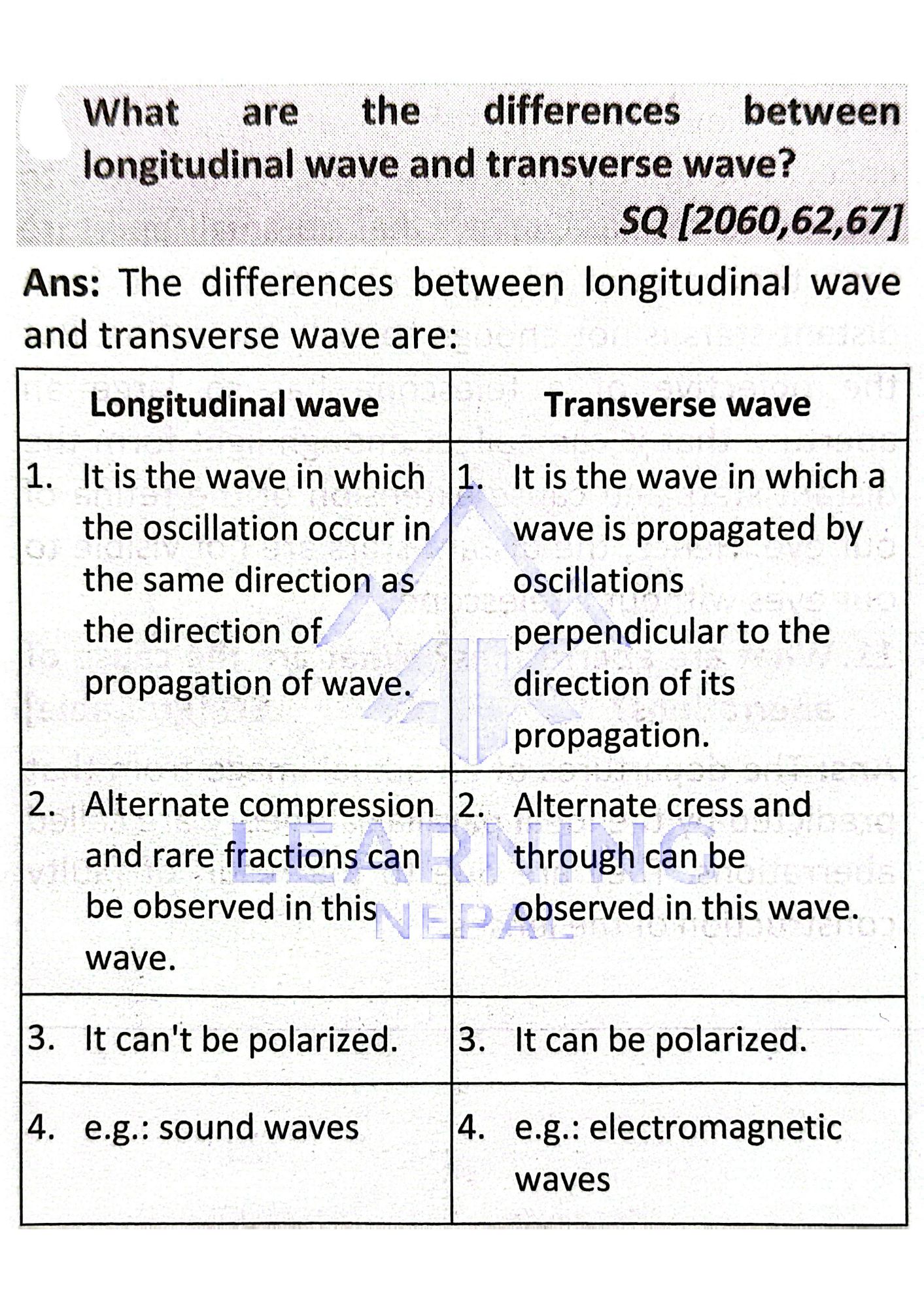
In physics we study the differences between longitudinal wave and transverse wave to understand the movement of particles and the direction of energy transfer in different wave types. In this guide, we will explain these differences with simple examples.

What Are Longitudinal and Transverse Waves?
A longitudinal wave is a wave in which particles of the medium move parallel to the direction of energy transfer. A transverse wave is a wave in which particles move perpendicular to the direction of energy transfer.
Key Differences Between Longitudinal Wave and Transverse Wave
- Direction of Motion: Longitudinal – parallel; Transverse – perpendicular.
- Examples: Longitudinal – sound waves; Transverse – water waves.
- Particle Movement: Parallel vs Perpendicular.
- Types of Medium: Longitudinal can travel through solids, liquids, gases; Transverse mainly through solids.
- Waveform: Compressional vs crest & trough pattern.
Understanding these differences helps in studying sound, light, and mechanical wave behavior across different mediums.
Keywords
differences between longitudinal wave and transverse wave, longitudinal vs transverse, wave direction, particle movement waves, types of waves, physics waves comparison, mechanical waves, sound wave type, light wave type, wave properties, medium and waves, compression vs crest, wave study, educational physics, learning waves
Tags
longitudinal wave, transverse wave, wave differences, physics, mechanical waves, sound waves, light waves, science education, wave properties, energy transfer, educational post, physics guide, learning waves, wave comparison,Differences Between Longitudinal Wave and Transverse Wave
Search more on Google:
Click Here
Differences Between Longitudinal Wave and Transverse Wave
Helpful resource:
Wave – Wikipedia