
Difference Between Standing and Progressive Wave – Full Guide
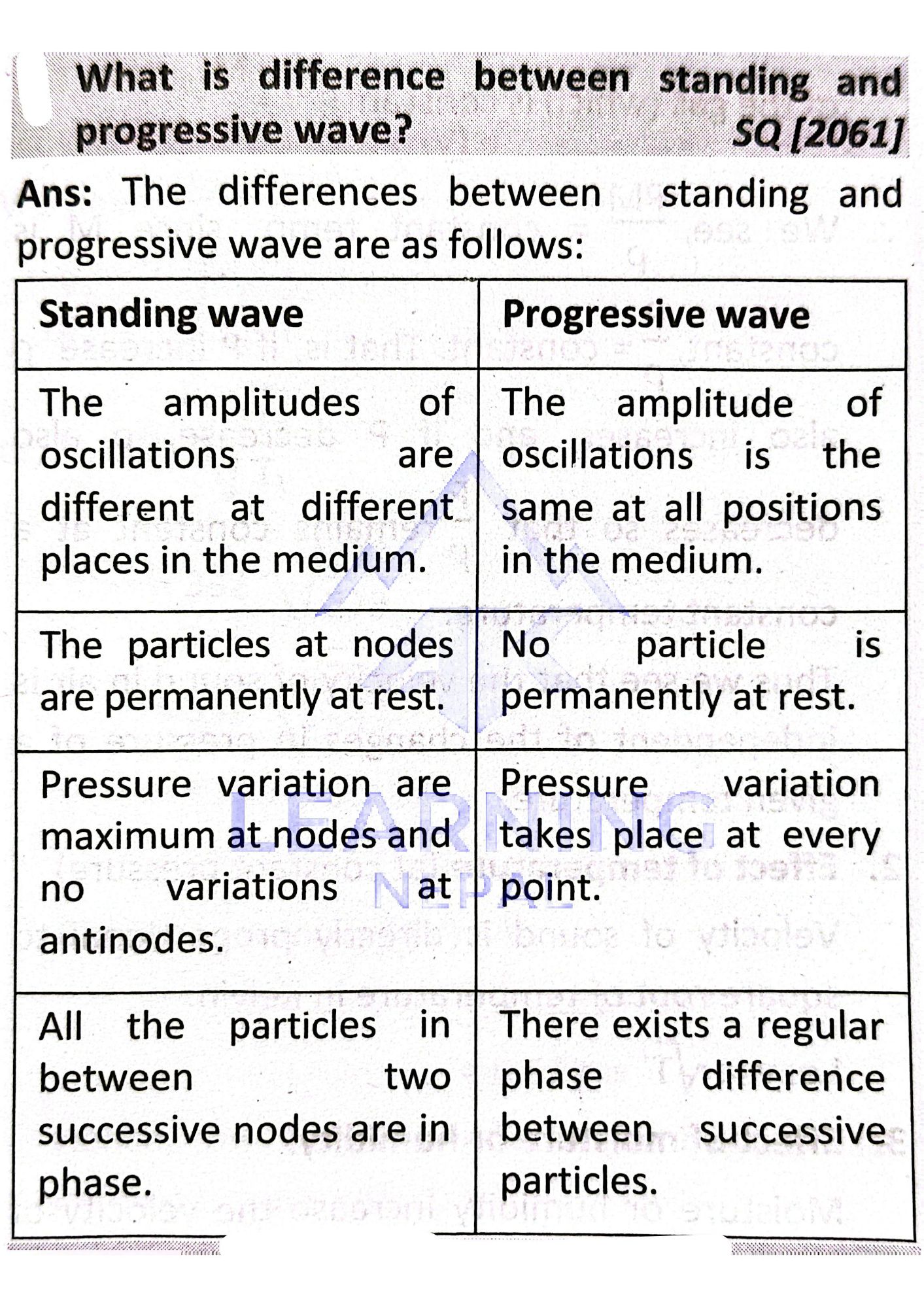
In physics, the difference between standing and progressive wave helps us understand how energy travels through a medium and how wave patterns form. This guide explains both wave types in a simple, educational way.

What Is a Standing Wave?
A standing wave is a wave that remains in a constant position. It appears stationary and is formed when two identical waves travel in opposite directions and interfere with each other.
What Is a Progressive Wave?
A progressive wave (also called a traveling wave) moves through a medium, carrying energy from one place to another without the particles of the medium staying in one fixed position.
Key Differences Between Standing and Progressive Wave
- Motion: Standing waves do not transfer energy; progressive waves do.
- Appearance: Standing looks stationary; progressive travels.
- Nodes/Antinodes: Present in standing waves; not in progressive waves.
- Energy Transfer: No net transfer in standing; yes in progressive.
- Formation: Standing forms by interference; progressive by continuous propagation.
Standing waves are common in strings and air columns, while progressive waves are seen in water ripples and sound moving through air.
Keywords
difference between standing and progressive wave, standing vs progressive wave, wave types comparison, physics wave basics, energy transfer waves, standing wave characteristics, progressive wave examples, wave behavior, nodes and antinodes, wave interference, traveling wave, wave patterns, mechanical waves, physics guide,Difference Between Standing and Progressive Wave
Tags
standing wave, progressive wave, wave differences, physics, wave motion, energy transfer, nodes and antinodes, wave types, educational post, learning physics, medium and waves, wave behavior, mechanical waves
Search more on Google:
Click Here
Read related post: (Internal Link Here)
Difference Between Standing and Progressive Wave
Waves – Wikipedia