
Difference Between Gas and Vapour
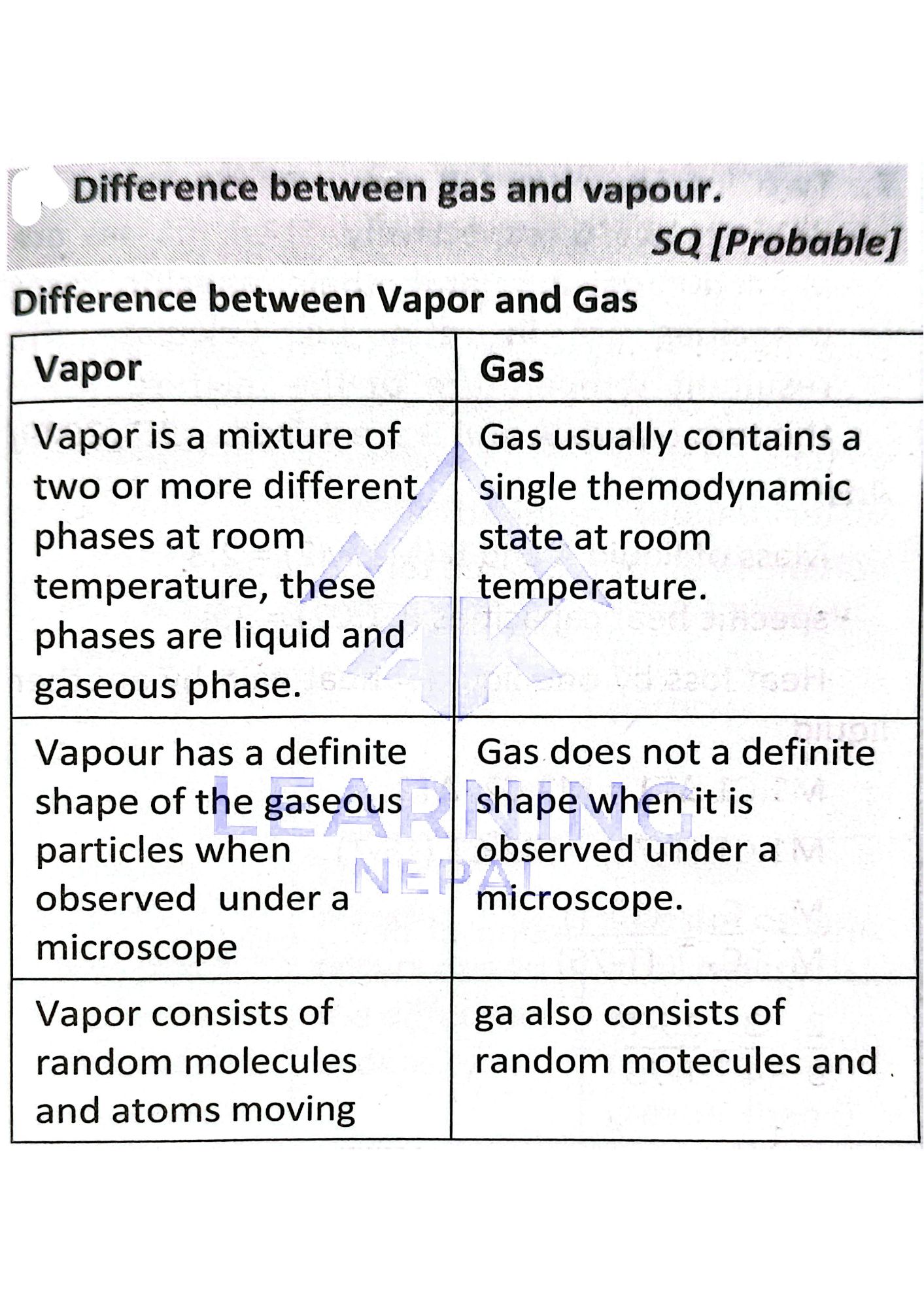

Difference Between Gas and Vapour — Though both gas and vapour are in gaseous form, there is a subtle but important difference based on their origin, behaviour under temperature/pressure, and ability to condense back to liquid or solid.
What is a Gas?
A gas is a substance in gaseous form at ordinary (room) temperature and pressure. Its natural physical state under those conditions is gas (for example, oxygen, nitrogen). :contentReference[oaicite:1]{index=1}
What is a Vapour?
Vapour is the gaseous form of a substance that under ordinary conditions would be liquid or solid. It arises when that substance evaporates or sublimates. Vapour can condense back into liquid or solid when temperature or pressure conditions change. :contentReference[oaicite:2]{index=2}
Key Differences: Gas vs Vapour
| Gas | Vapour |
|---|---|
| Substance whose natural state at room temperature/pressure is gaseous. :contentReference[oaicite:3]{index=3} | Gaseous state of a substance which is normally liquid or solid at room temperature. :contentReference[oaicite:4]{index=4} |
| Does not condense to liquid under normal conditions (unless cooled below critical temperature or compressed very highly). :contentReference[oaicite:5]{index=5} | Can condense back into liquid (or solid) when temperature/pressure falls below boiling/condensation point. :contentReference[oaicite:6]{index=6} |
| Exists independently at ordinary temperatures and pressures. :contentReference[oaicite:7]{index=7} | Exists only under conditions when original liquid/solid can vaporize; its existence is conditional on evaporation/sublimation. :contentReference[oaicite:8]{index=8} |
| Examples: Oxygen (O₂), Nitrogen (N₂), Hydrogen (H₂). :contentReference[oaicite:9]{index=9} | Examples: Water vapour (from water), Iodine vapour (from solid iodine). :contentReference[oaicite:10]{index=10} |
Difference Between Gas and Vapour
Read More About Gas vs Vapour (DoFollow)