
Can a Body Be Regarded in a State of Rest as Well as in Motion at the Same Time?
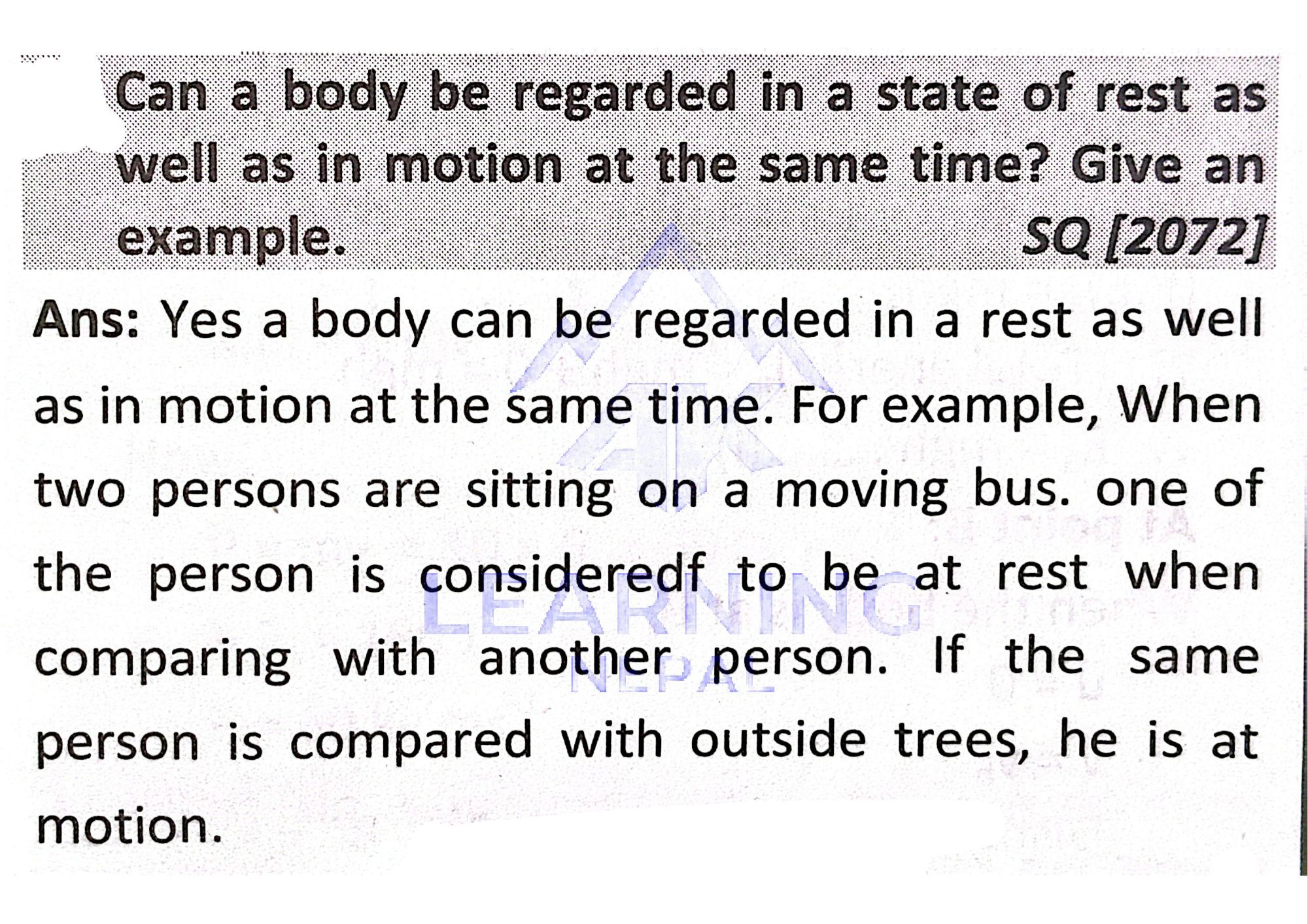

Can a body be regarded in a state of rest as well as in motion at the same time? — Yes, depending on the observer’s frame of reference. What appears “at rest” to one observer may be “in motion” to another. This is the core idea of relative motion in physics.
What is Relative Motion?
In physics, motion or rest of any body is always defined with respect to some reference frame. If the position of the body does not change with time relative to that frame → it is at rest. If the position changes → it is in motion. :contentReference[oaicite:0]{index=0}
How Can the Same Body Be In Rest And Motion Together?
A body may be at rest relative to one object (or observer) and at the same time be in motion relative to another. For example:
- If you sit inside a moving bus — relative to the bus, you are at rest (your position doesn’t change) but relative to a person standing on the road, you are in motion. :contentReference[oaicite:1]{index=1}
- A book lying on the table is at rest relative to the table, but since the Earth rotates and moves around the Sun, the book is also moving relative to the Sun (or to space at large) — so motion or rest depends on chosen reference frame. :contentReference[oaicite:2]{index=2}
Why This Matters in Physics
This relativity of motion implies there is no absolute rest — all motion (or rest) is relative to a chosen frame. For correct analysis, one must specify the reference frame before saying a body is “at rest” or “in motion”. :contentReference[oaicite:3]{index=3}
Related: Internal link here
Read More About Relative Motion (DoFollow)
Keywords
Tags
Can a Body Be Regarded in a State of Rest as Well as in Motion at the