
Angle Between Vec A and Vec B: Quick Proof & Examples
If vec A – vec B = 0 what is the angle between vec A and vec B
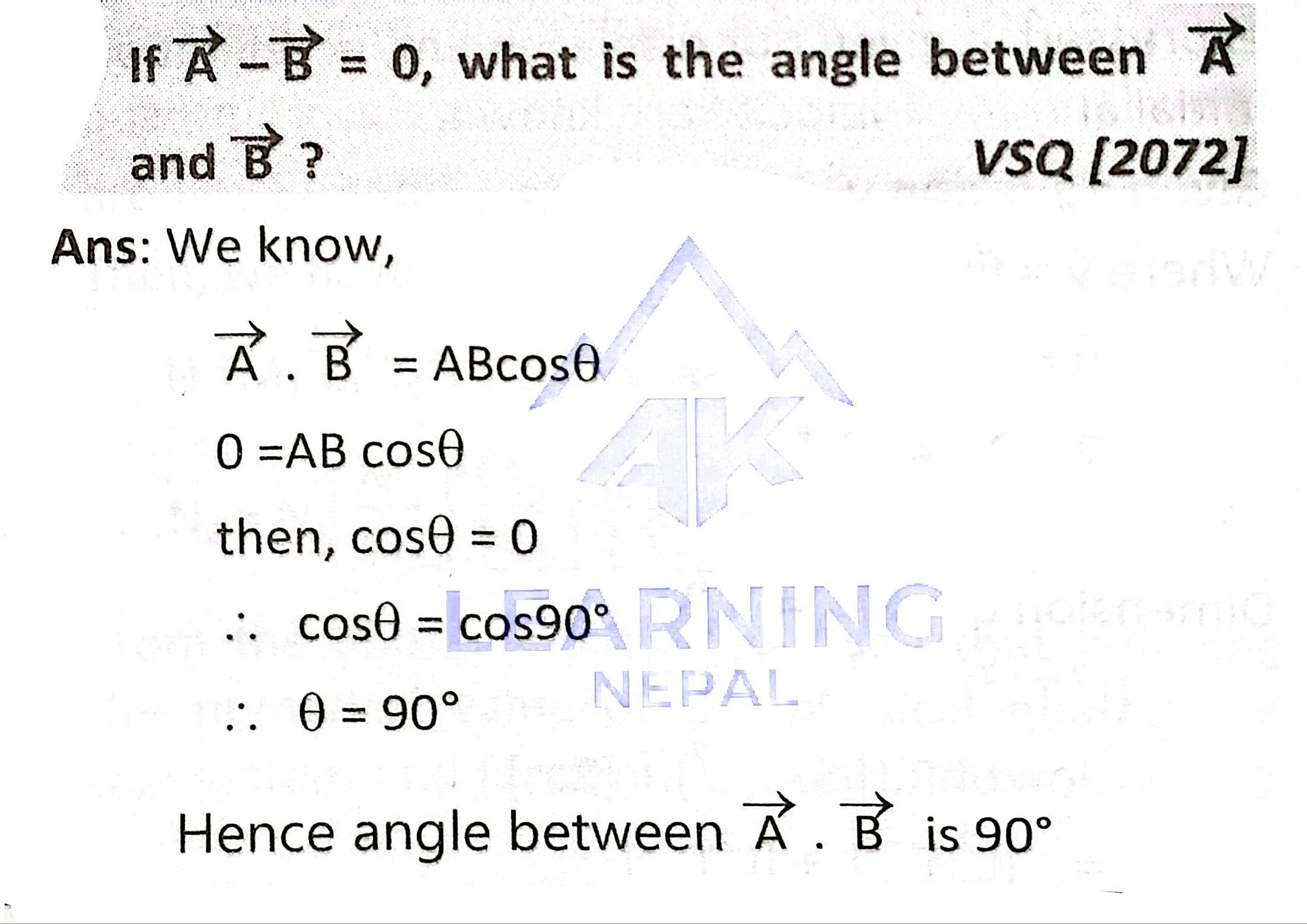

This lesson explains how to determine the angle between vec a and vec b when their dot product equals zero. We give a concise proof, intuitive geometric meaning, quick examples, and a practice question so you can master the concept.
What the problem states
You’re given that vec a · vec b = 0. The task: find the angle between vec a and vec b. This is a classic vector identity that links algebra (dot product) and geometry (angle between vectors).
Short formula reminder
The dot product formula between two non-zero vectors a and b is:
vec a · vec b = |a| |b| cos θ,
where θ is the angle between vec a and vec b.
Note
If vec a · vec b = 0 and both vectors are non-zero, the equation |a| |b| cos θ = 0 implies cos θ = 0. Therefore the angle between vec a and vec b is 90° (π/2 radians).
Why — short proof
Start with vec a · vec b = |a||b| cos θ. Given vec a · vec b = 0 and assuming |a| ≠ 0 and |b| ≠ 0 (non-zero vectors), divide both sides by |a||b| to get cos θ = 0. The only angles in [0, π] whose cosine is zero are θ = π/2, i.e., 90°. So the angle between vec a and vec b is 90°.
Geometric intuition
When two vectors are orthogonal (dot product zero), one has no component in the direction of the other. Graphically, they meet at a right angle. This is why angle between vec a and vec b = 90° is simply the orthogonality condition.
Example
Let vec a = (2, -3, 1) and vec b = (3, 2, 1). Compute the dot product: 2·3 + (−3)·2 + 1·1 = 6 − 6 + 1 = 1. Here the dot product ≠ 0, so the vectors are not orthogonal and the angle between vec a and vec b is not 90°. For truly orthogonal examples, pick vectors like (1,0,0) and (0,1,0) — their dot product is 0 and the angle between vec a and vec b = 90°.
Practice question
If vec a = (a₁,a₂) and vec b = (b₁,b₂) and a₁b₁ + a₂b₂ = 0, what is the angle between vec a and vec b? Answer: 90°.
Want to learn more about the dot product? See this detailed explanation on
Wikipedia — Dot product.
For other lessons on vectors, check our Vectors Basics page.
Key takeaways
- The condition vec a · vec b = 0 (with non-zero vectors) means the vectors are orthogonal.
- The angle between vec a and vec b is 90° (π/2 radians).
- Use the dot product formula |a||b| cos θ to connect algebra to geometry.
If vec a · vec b = 0 and |a|,|b| ≠ 0 ⇒ cos θ = 0 ⇒ θ = 90°.
Tags
angle between vec a and vec b
dot product zero
orthogonal vectors
vectors geometry
vector dot product formula
angle in 3D
unit vectors angle
vector projections
orthogonality examples
perpendicular vectors
angle formula
linear algebra dot product
vectors for students
vector questions
Meta note: Make sure the page URL slug contains the focus keyword, e.g. /angle-between-vec-a-and-vec-b, and paste the SEO Title and Meta Description into the page head for best results.