
An object of mass 10 kg is moving with a velocity of 6 m/s — calculate its kinetic energy and its momentum.
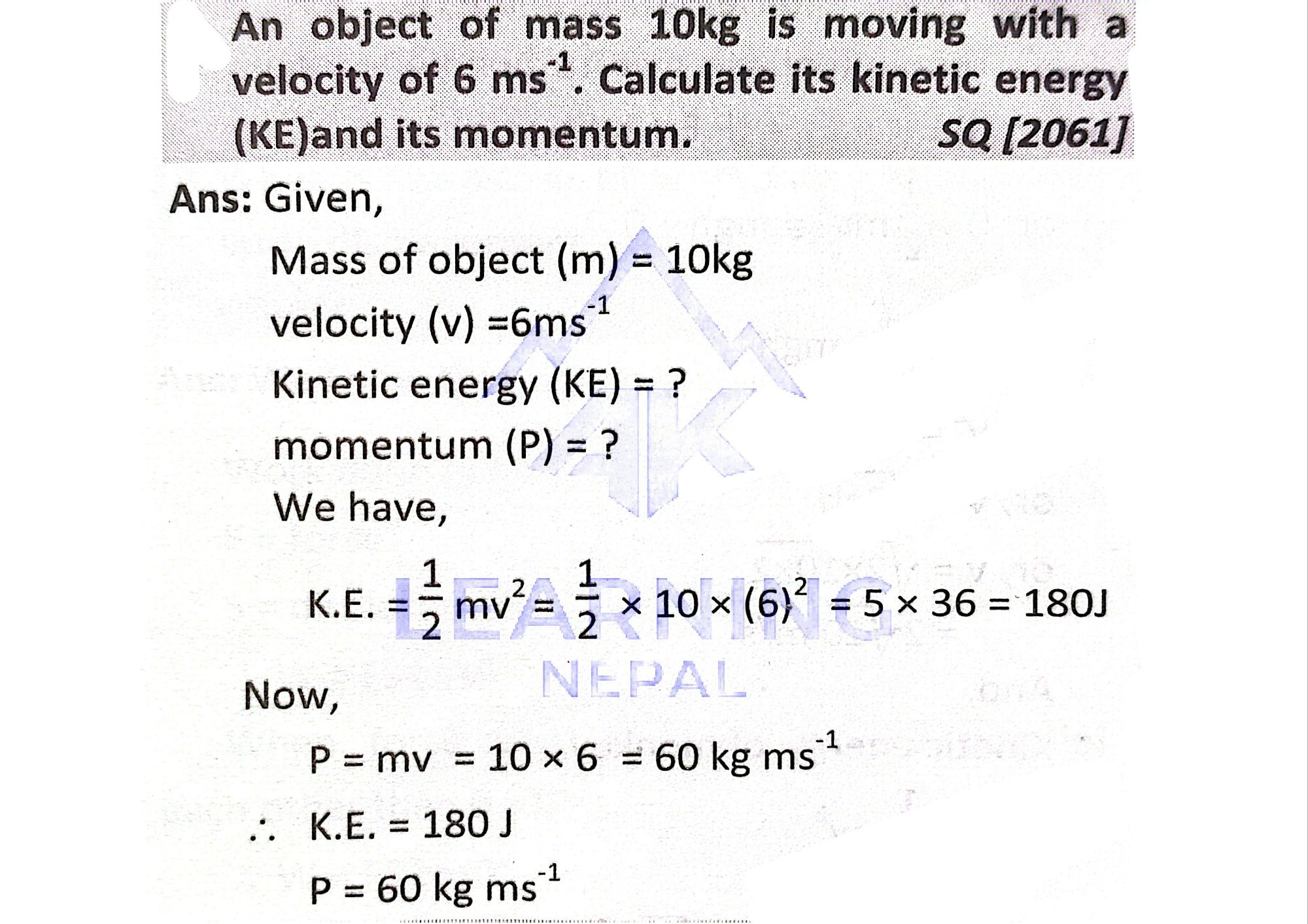

An object of mass 10 kg is moving with a velocity of 6 m/s — calculate its kinetic energy and its momentum. This classic physics problem demonstrates how to compute two fundamental quantities: kinetic energy and linear momentum of a moving object.
Formulas for Kinetic Energy and Momentum
The kinetic energy (KE) of a body of mass m moving with speed v is given by:
KE = ½ m v². :contentReference[oaicite:0]{index=0}
The linear momentum (p) of a body of mass m moving with velocity v is:
p = m v. :contentReference[oaicite:1]{index=1}
Calculation for Given Object
- Mass, m = 10 kg
- Velocity, v = 6 m/s
So, KE = ½ × 10 × (6)² = ½ × 10 × 36 = 180 Joules
And, Momentum, p = 10 × 6 = 60 kg·m/s
Interpretation
This means when the 10 kg object moves at 6 m/s, it has a kinetic energy of 180 J — energy due to its motion — and a momentum of 60 kg·m/s, reflecting quantity of motion with direction. Kinetic energy is a scalar, momentum is a vector. :contentReference[oaicite:2]{index=2}
Related: Internal link here
Read More About Momentum & Kinetic Energy (DoFollow)