
Basic Medical Procedure and First Aid

General Medicine (HA) – Second Year
Unit 5: Invasive Procedures
Importance of Invasive Procedures
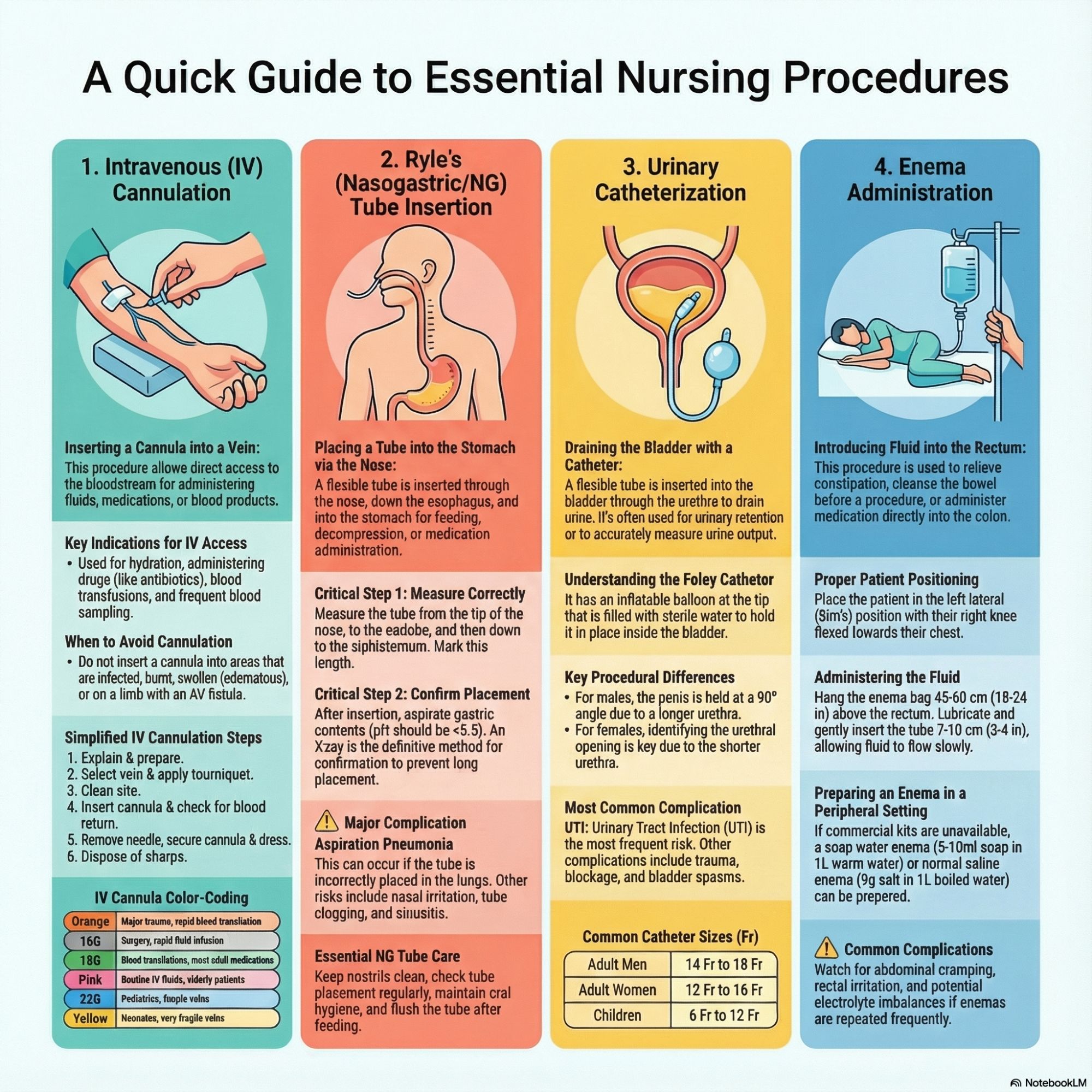
Invasive procedures are essential clinical skills that involve entering the body through natural orifices or through the skin. These procedures require precision, strict aseptic technique, and thorough knowledge of anatomy to ensure patient safety and therapeutic effectiveness. This unit covers four critical invasive procedures: IV cannulation, nasogastric tube insertion, urinary catheterization, and enema administration.
Mastering these skills is crucial for emergency care, surgical preparation, and management of critically ill patients. Follow the Basic Medical Procedures and First Aid Page for more resources.
1. Intravenous (IV) Cannulation
Definition & Purpose
Definition: Procedure of inserting a cannula into a vein to administer fluids, medications, blood products, or nutrition directly into the bloodstream.
Indications
- IV fluids administration (hydration)
- IV medications (antibiotics, analgesics)
- Blood/blood product transfusions
- Frequent blood sampling
- Contrast administration for imaging
- Parenteral nutrition
Contraindications
- Infected or inflamed area
- Burnt skin
- Edematous limb
- Limb with AV fistula
- Cellulitis over insertion site
- Mastectomy on same side
Procedure Steps
Explain procedure to patient
Wash hands and wear gloves
Select suitable vein
Clean site with antiseptic
Apply tourniquet
Insert cannula at proper angle
Check blood return
Remove needle and secure
Fix with dressing and label
Dispose sharps safely
IV Cannula Color Coding
| Color | Gauge (G) | Lumen Size | Common Uses |
|---|---|---|---|
| Orange | 14G | Very Large | Major trauma, rapid blood transfusion, surgery |
| Grey | 16G | Large | Surgery, blood transfusion, rapid fluid infusion |
| Green | 18G | Medium | Blood transfusion, IV fluids, most adult medications |
| Pink | 20G | Small | Routine IV medications, IV fluids, elderly patients |
| Blue | 22G | Very Small | Pediatrics, fragile veins, chemotherapy |
| Yellow | 24G | Smallest | Neonates, very fragile veins |
Complications and Management
| Complication | Management |
|---|---|
| Infiltration Fluid leaks into surrounding tissue |
Remove cannula, elevate limb, apply warm/cold compress, document |
| Phlebitis Vein inflammation |
Remove cannula, apply warm compress, elevate limb, consider NSAIDs |
| Infection Local or systemic |
Maintain aseptic technique, remove cannula, send tip for culture, antibiotics if needed |
| Hematoma Blood collection in tissue |
Apply pressure, cold compress, elevate limb |
| Air Embolism Air enters bloodstream |
Prevent by priming tubing, left lateral position if occurs, oxygen therapy |
| Thrombosis Blood clot in vein |
Remove cannula, avoid that vein, consider anticoagulants |
2. Ryle’s (Nasogastric/NG) Tube Insertion & Care
Definition & Indications
Definition: Insertion of a flexible tube through nose → esophagus → stomach.
Indications
- Feeding patients who cannot swallow
- Gastric decompression (post-surgery, obstruction)
- Administration of medications
- Gastric lavage (poisoning)
- Aspiration of gastric contents for analysis
Common Sizes (French Gauge)
- Adults: 12 Fr to 18 Fr
- Children/Infants: 5 Fr to 12 Fr
- Smaller for feeding, larger for drainage
Procedure Steps
- Explain & Position: Sitting upright, head slightly forward
- Measure & Mark: Nose → earlobe → xiphisternum
- Lubricate & Insert: Water-soluble gel, advance horizontally
- Swallow & Advance: Patient swallows water as tube advanced
- Confirm Placement: CRITICAL – Aspirate gastric contents (pH <5.5) or X-ray
- Secure & Care: Secure to nose, provide mouth/nasal care
⚠️ Critical Safety Point
Always confirm tube placement before feeding or medication administration. Chest X-ray is gold standard for initial placement confirmation.
Complications
- Incorrect placement → aspiration pneumonia
- Nasal/pharyngeal irritation, ulceration
- Sinusitis, otitis media
- Tube clogging
- Aspiration of gastric contents
- Electrolyte imbalance (prolonged drainage)
- Tube migration/dislodgement
Care of NG Tube
- Keep nostrils clean and moisturized
- Check tube placement regularly (before each feed)
- Maintain oral hygiene (mouth care every 4-6 hours)
- Flush tube with 30ml water before/after feeding/meds
- Secure properly to prevent dislodgement
- Monitor for signs of complications
- Document tube length at nostril daily

3. Urinary Catheterization
Definition & Types
Definition: Insertion of a hollow, flexible tube into the bladder to drain urine.
Foley’s Catheter
Flexible tube with balloon at tip. After insertion, balloon inflated with sterile water to keep in place.
Common Sizes (French Gauge)
- Adult Men: 14 Fr to 18 Fr
- Adult Women: 12 Fr to 16 Fr
- Children: 6 Fr to 12 Fr
- Balloon sizes: 5ml, 10ml (standard), 30ml
Indications & Procedure
Indications
- Relief of urinary retention
- Accurate urine output measurement
- Bladder irrigation (clot removal)
- Urinary incontinence management
- During certain surgeries
- Urine specimen collection
General Procedure Steps
- Explain procedure, maintain privacy
- Wash hands, wear sterile gloves
- Clean genital area with antiseptic
- Lubricate catheter tip
- Insert catheter gently into urethra
- Inflate balloon with sterile water
- Connect to drainage bag, secure
- Document procedure
👨 Male Catheterization
- Penis held at 60-90° angle
- Longer urethra (18-20 cm)
- Advance 15-20 cm until urine flows
- Risk of false passage creation
- More care needed for prostate enlargement
- Secure to abdomen or thigh
👩 Female Catheterization
- Shorter urethra (4-5 cm)
- Advance 5-7 cm until urine flows
- Identify urethral opening clearly
- Risk of vaginal misplacement
- Labia must be separated throughout
- Secure to inner thigh
Complications of Catheterization
Most common complication
False passage creation
Long-term in males
Painful contractions
Sediment or kinking
Discomfort during insertion/removal
4. Enema Administration
Definition & Types
Definition: Introduction of fluid into rectum and colon via anus.
Types of Enema
- Evacuant/Cleansing: Relieve constipation, bowel prep
- Retention: Medication administration (steroids for colitis)
- Carminative: Relieve flatulence
- Anthelmintic: Treat parasitic infections
- Nutritive: Provide nutrition (rare)
Indications
- Relieve constipation
- Bowel preparation before surgery/colonoscopy
- Administer medications
- Soften fecal impaction
- Reduce body temperature (rare)
- Diagnostic procedures
Procedure Steps (Evacuant Enema)
- Prepare: Explain, privacy, left lateral position
- Prepare Solution: Warm to 37°C (500-1000ml)
- Hang Container: 45-60 cm above rectum
- Lubricate & Insert: Lubricate 3-5 cm of tube
- Insert Tube: 7-10 cm into rectum
- Administer: Open clamp, allow slow flow
- Retain & Expel: Retain 5-10 minutes, then expel
- Clean & Document: Clean patient, document output
⚠️ Important Points
- Stop if severe cramping occurs
- Never force tube insertion
- Monitor for vasovagal response
- Use appropriate solution temperature
Local Method Preparation
When commercial kits unavailable in peripheral settings:
Equipment Needed
- Clean bucket/vessel
- Rubber/silicone tubing
- Funnel or clamp
- Soap, clean water, salt
Solution Preparation
- Soap Water: 1L warm water + 5-10ml mild soap
- Normal Saline: 1L boiled water + 9g salt (0.9%)
Sterilize equipment by boiling if possible. Emphasis on cleanliness to prevent infection.
Complications of Enema
Mucosal damage
During/after administration
Repeated enemas
Rare but serious
Poor technique
Syncope, bradycardia
📚 Memory Aids & Key Points
IV Cannula Selection
Large (14-16G): “Orange/Grey for Trauma & Surgery”
Medium (18G): “Green for General Use”
Small (20-24G): “Pink/Blue/Yellow for Fragile Veins”
NG Tube Placement Check
5 Methods:
1. Aspirate gastric contents (pH <5.5)
2. X-ray confirmation (gold standard)
3. Listen for air insufflation
4. Visual inspection of aspirate
5. Capnography if available
Catheterization Tips
- Men: “Lift and Straighten”
- Women: “Separate and Visualize”
- Always: “Lubricate Generously”
- Never: “Force the Catheter”
🩺 Clinical Tips & Best Practices
Universal Principles
- Always obtain informed consent
- Maintain strict aseptic technique
- Ensure adequate patient preparation
- Provide privacy and dignity
- Document everything thoroughly
Patient Comfort
- Use distraction techniques
- Apply local anesthetic when possible
- Maintain clear communication
- Monitor for pain/discomfort
- Provide aftercare instructions
Safety Measures
- Double-check equipment functionality
- Have emergency equipment available
- Follow sharps safety protocols
- Monitor for complications
- Know when to seek assistance
Topic Tags
IV Cannulation
Nasogastric Tube
NG Tube Insertion
Urinary Catheterization
Foley Catheter
Enema Administration
Clinical Skills
Procedure Technique
IV Cannula Sizes
Tube Feeding
Gastric Decompression
Bladder Drainage
Bowel Preparation
Constipation Management
Aseptic Technique
Procedure Complications
Patient Safety
Healthcare Procedures
Medical Techniques
📋 Summary & Key Points
- IV Cannulation: Choose appropriate gauge based on purpose, monitor for complications
- NG Tube: Always confirm placement before use, provide meticulous nasal/oral care
- Catheterization: Use strict aseptic technique, minimize duration to reduce UTI risk
- Enema: Use correct solution and temperature, monitor for adverse reactions
- Universal Principles: Informed consent, aseptic technique, patient comfort, thorough documentation
- Complications: Know early signs and appropriate management for each procedure
- Local Adaptations: Learn to adapt procedures for resource-limited settings safely
For more resources, contact via WhatsApp: 9816819593 or visit CTEVT Nepal