
Explain Bragg’s Law of Diffraction of X-rays
Bragg’s Law of Diffraction of X-rays explains the condition under which X-rays are strongly reflected by the crystal planes.
Bragg’s Law of Diffraction of X-rays is a very important topic in modern physics.
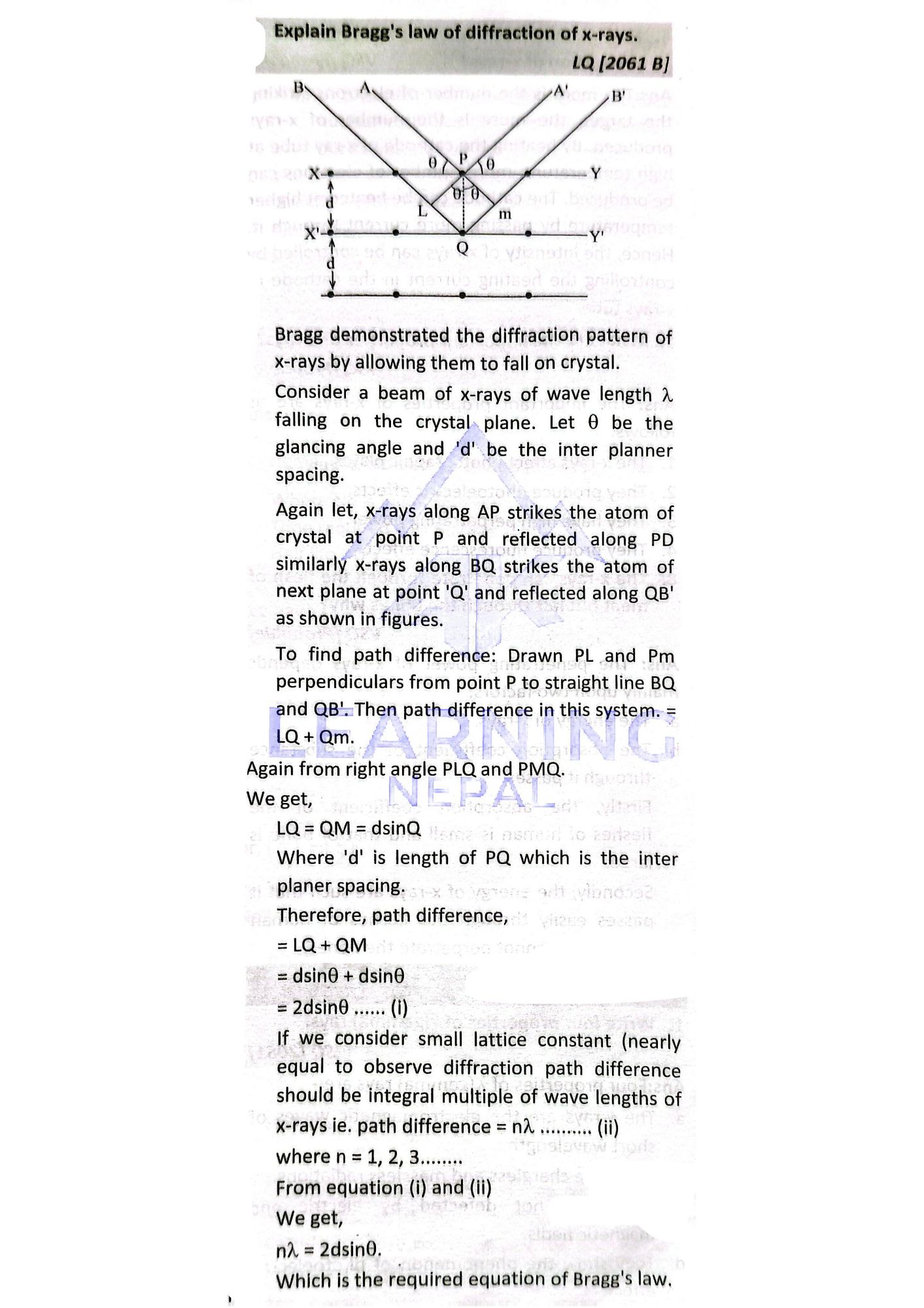
Bragg’s Law of Diffraction of X-rays (Statement)
According to Bragg’s Law of Diffraction of X-rays, when X-rays fall on a crystal, the reflected rays from successive
atomic planes interfere constructively only when the path difference between them is equal to an integral multiple of wavelength.

Bragg’s Law of Diffraction of X-rays (Explanation)
In a crystal, atoms are arranged in parallel planes. When X-rays strike these planes, part of the rays are reflected from each plane.
Constructive interference occurs only for specific angles, producing intense diffraction maxima.
This phenomenon is explained by Bragg’s Law of Diffraction of X-rays.
In exams, Bragg’s Law of Diffraction of X-rays is usually asked as a short or long answer question.
Always mention the condition of constructive interference clearly.
👉 External reference:
Bragg’s Law (DoFollow)
Explain Bragg’s Law of Diffraction of X-rays
Bragg’s Law of Diffraction of X-rays
Bragg’s Law of Diffraction of X-rays, Bragg’s law, X-ray diffraction, diffraction of X-rays, crystal planes, modern physics, Class 12 physics, NEB physics, CTEVT physics, X-rays notes, diffraction theory, exam oriented physics, physics derivation, board exam questions, physics guide,Explain Bragg’s Law of Diffraction of X-rays