
What do you mean by 1 eV?
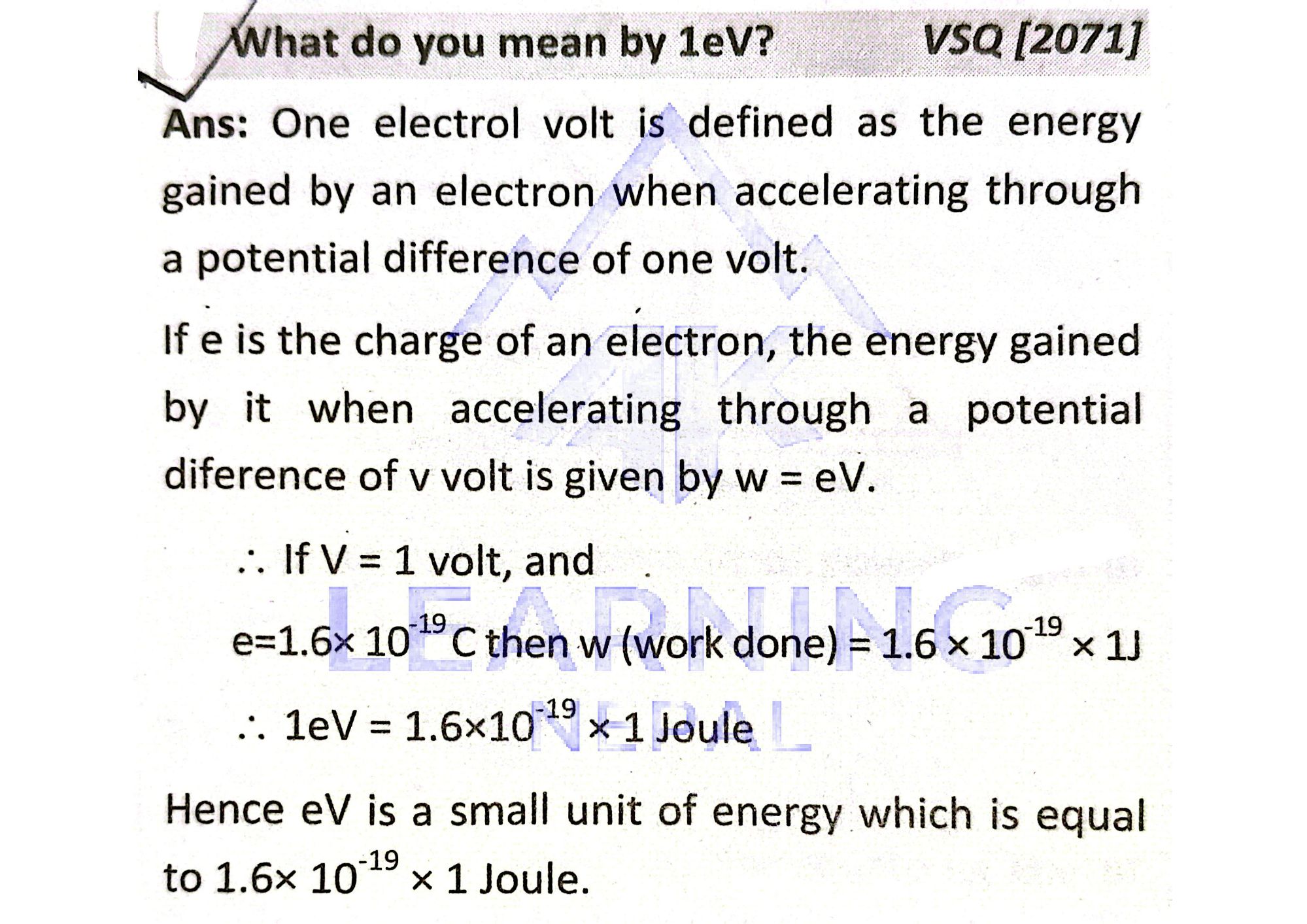

What do you mean by 1 eV? A common physics unit in atomic and particle physics, “electron volt” represents a specific amount of energy gained by an electron accelerated through an electric potential difference of 1 volt.
Definition of 1 eV
An electron volt (eV) is the amount of kinetic energy acquired (or work done on) an electron when it is accelerated through a potential difference of 1 volt. It is a very small energy unit used in atomic and nuclear physics.
Formula and Meaning
By definition:
1 eV = 1 electron × 1 volt.
Since 1 volt = 1 joule per coulomb and electron charge ≈ 1.602×10⁻¹⁹ C, we get:
1 eV ≈ 1.602 × 10⁻¹⁹ joules (J)
Physical Interpretation
When an electron is moved through a potential difference (electric field) of 1 volt, the energy it gains or loses is exactly 1 eV. This makes eV a convenient unit in microscopic energy scales like atomic binding energy, photon energy, and particle collisions.
What do you mean by 1 eV?
Read More About Electron Volt (DoFollow)