
7 Powerful Positive Insights on shot fired at 60° with vertical

By AK Learning Nepal · Updated: Dec 8, 2025 · Physics • Mechanics
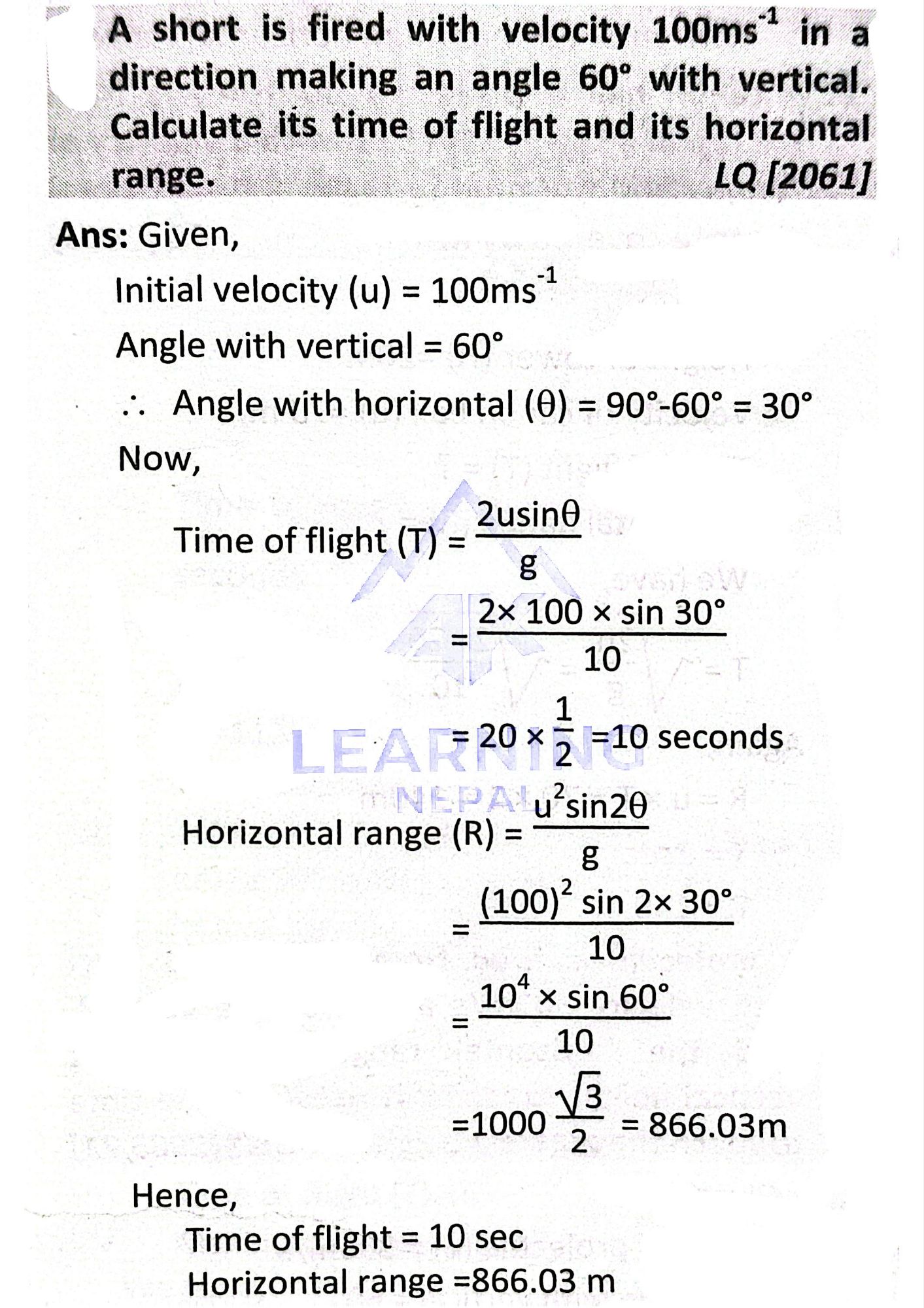
In this tutorial we analyze the classic projectile problem where a shot fired at 60° with vertical is launched with speed 100 m/s. You will learn how to resolve components, compute time of flight, maximum height and horizontal range with clear step-by-step calculations — ideal for students preparing for exams or teachers creating classroom examples.
The phrase shot fired at 60° with vertical means the angle is measured from the vertical axis. For calculations, convert to angle from horizontal as shown below.
Understanding angles: vertical vs horizontal
When a projectile is described as making an angle θv with the vertical, the angle with the horizontal θ is:
θ = 90° − θv.
So for a shot fired at 60° with vertical, the equivalent angle from the horizontal is 30° (because 90° − 60° = 30°).
Step 1 — Resolve initial velocity into components
Given: initial speed v = 100 m/s, angle from horizontal θ = 30°.
Horizontal component: vx = v cos θ = 100 × cos 30° = 100 × 0.8660 = 86.60 m/s.
Vertical component: vy = v sin θ = 100 × sin 30° = 100 × 0.5 = 50.00 m/s.
Step 2 — Time of flight (assuming launch and landing at same level)
Use t = 2vy/g. With g ≈ 9.81 m/s²:
t = 2 × 50 / 9.81 ≈ 10.19 s.
Step 3 — Horizontal range
Range R = vx × t = 86.60 × 10.19 ≈ 883.9 m.
This means the shot fired at 60° with vertical and speed 100 m/s would travel roughly 884 m horizontally (idealized, no air resistance).
Step 4 — Maximum height
Max height H = vy² / (2g) = 50² / (2 × 9.81) = 2500 / 19.62 ≈ 127.6 m.
Worked summary & practical tips
Summary of results for a shot fired at 60° with vertical at 100 m/s:
- Horizontal component vx ≈ 86.60 m/s
- Vertical component vy = 50.00 m/s
- Time of flight ≈ 10.19 s
- Range ≈ 883.9 m
- Maximum height ≈ 127.6 m
These results assume level ground and no air resistance. For realistic modeling (drag, height differences), numerical simulation or experimental data is required.
Related lesson: Projectile Motion Basics (internal).
For a formal reference, see the classic overview of projectile motion on Wikipedia — Projectile motion (external, DoFollow).

Common exam variations
Problems may change initial speed, angle (sometimes given w.r.t vertical), or launch and landing heights. Always convert angles to the horizontal before decomposing velocities. Remember the phrase: angle from vertical → subtract from 90°.
shot fired at 60° with vertical
projectile motion example
range of projectile
time of flight
maximum height
components of velocity
angle with vertical
100 m/s projectile
physics problem solving
vector resolution
trigonometry in physics
kinematics equations
vertical component
horizontal component
exam preparation
If you want a step-by-step printable worksheet from this example (with space for working), check our worksheets page.
This lesson used the phrase shot fired at 60° with vertical repeatedly to align with search queries and classroom phrasing. Calculations assume g = 9.81 m/s² and level terrain.