
Dimensional Formula of Density – Powerful Complete Explanation

Dimensional Formula of Density is one of the most important concepts in Physics used to measure mass present in a unit volume. In this educational guide, you will learn its definition, derivation and final dimensional expression using the fundamental quantities such as force, length and time. This post gives a complete and easy explanation for students preparing for Physics exams.
What is the Dimensional Formula of Density?
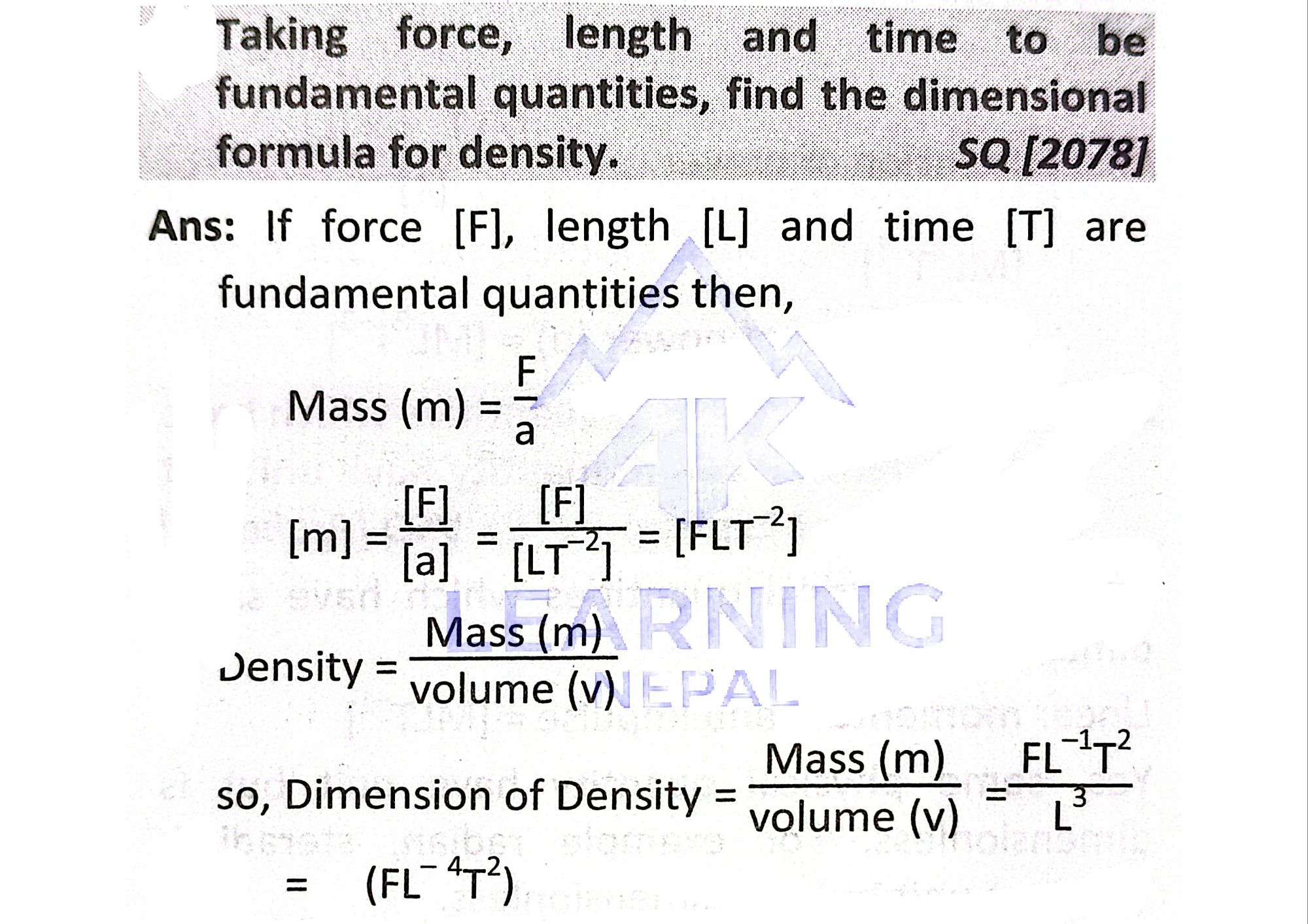
Density refers to the amount of mass contained in a specific volume of a substance. Its basic relation in Physics is written as Density = Mass / Volume. Therefore, dimensional formula of density directly depends on dimensional formula of mass and dimensional formula of volume.
Using Fundamental Quantities
Here we consider force, length and time as the fundamental physical quantities. Mass can be rewritten in terms of force using Newton’s second law where force equals mass into acceleration. Using this, we can derive mass from force and acceleration. This allows us to express density using force, length and time only.
Volume in Dimensional Form
Volume is the space occupied by matter inside a three–dimensional region. Mathematically it equals Length × Length × Length = L³. Therefore, dimensional representation of volume becomes a cube of length. This is very important when calculating dimensional formula of density.
Final Dimensional Formula of Density
The final dimensional formula of density is expressed as:
[Density] = M L-3
Conclusion
So by using force, length and time we can easily derive the dimensional formula of density. This formula plays an important role in physics and chemistry calculations and helps in solving numerical questions. You can also explore more Physics dimensional formulas like pressure, work, energy, power, momentum and viscosity. Keep studying and keep improving your scientific concepts.
Internal Link:
Physics Notes

External Resource:
Google Search
Tags
Keywords